

S2603 - OWE Off-piste Panama 23 March
Borealis arrived in Amador, Panama, early morning on the 23rd March 2026. The OWE team (Peter Howlett and Jeff Clarke) had arranged a tour with a local bird guide through Beautiful Tours Panama. Once ashore we met up with Rafa and were soon headed towards the famous birding site of Pipeline Road. Our start point was ‘The Ammo Ponds’, very close to ‘Herman the German’, the famous floating crane in the dock site at Gamboa along the Panama Canal.

In a small wetland we found a good variety of birds including Wattled Jacana, Panama Flycatcher, Crimson-rumped Tanager, Rusty-margined Flycatcher and Rufescent Tiger Heron. There was also a reptile present in the form of Black Iguana, several were sunning themselves on a bank above the water.
Wattled Jacana Panama Flycatcher Crimson-rumped Tanager Black Iguana
The heat was already rising rapidly and so the decision was made to head straight to the Panama Rainforest Discovery Centre, in the hope that birds might still be active by the time we reached the top of the canopy tower.
To get there required a drive along the Pipeline Road and there was no way we were going to get along there without at least a couple of stops – particularly when you see birders with guides stopped looking at something! First stop was for a Slaty-tailed Trogon, which was very nice but perhaps outshone by the fantastically named Checker-throated Stipplethroat which was ferreting around in some dense foliage a few metres from the trogon. A few hundred metres further on we stopped again, this time for a female Graceful Black-throated Trogon, she was sat in a much more useful position for photos.
Slaty-tailed Trogon Checker-throated Stipplethroat Graceful Black-throated Trogon
We were soon at the Rainforest Centre and made a beeline for the tower. As we were approaching the tower a woodcreeper flicked across the path in front of us and landed on a nearby trunk – Northern-barred Woodcreeper, an excellent start. These birds behave like and are a similar shape to our Treecreeper but are the size of a Blackbird – impressive beasts. Moments after reaching the top of the tower a Bat Falcon zipped past and then circled up to join a couple of Turkey Vultures. As we feared, the heat was already oppressive and canopy birds were virtually absent, though we could hear a motmot calling.
Northern Barred Woodcreeper Bat Falcon
We headed for a nearby lake; on the way we enjoyed a motmot double. A Broad-billed Motmot sat in typically motionless pose very close at hand, moments later an almost subliminally quick shape whipped behind the Broad-bill and there sat its look-alike, the somewhat larger Rufous Motmot. Motmots have a broad diet, very often pouncing on a tasty invertebrate but also quite partial to fruit.
Broad-billed Motmot Rufous Motmot
The lake was quiet; a family group of Smooth-billed Ani was slim pickings for this normally reliable location. We retraced our steps back toward the Discovery Centre and, at an intersection, we chanced on a flock of passerines; White-shouldered Tanager, Dot-Winged Antwren, Dusky Antbird and a few elusive American Wood Warblers.
In the trees behind we could see the sprawled forms of Mantled Howler Monkeys, their unearthly vocalisations are a constant backdrop of this forested region. We were on the point of giving up when a movement caught our eye, it turned out to be a Black-bellied Wren, it did it’s best to avoid being photographed but eventually Pete caught it in a gap in the tangle, complete with a rather large insect larvae.

Literally around the corner from these birds, we came to the spot where we saw the motmots earlier, the Broad-billed was still there, in an even more inviting position than earlier.
As we reached the centre a pair of stunningly beautiful Whooping Motmot grabbed our attention. A three-motmot morning is a memorable thing. Photogenic as any bird in the forest. What a treat!
White-necked Jacobin Long-billed Hermit
But the goodies would keep piling up, even as we took a bit of R&R we had the company of four species of hummer, the ever delightful White-necked Jacobin, Long-billed Hermit, and dazzling Violet-bellied Hummingbird. These birds are attracted to the centre by an array of hummingbird feeders, and they come in their droves to take advantage of a free meal.
In one corner of the centre’s roof canopy was a nest. It belonged to a Bright-rumped Attila.
Before long it announced its return and then attended the nest. Once satisfied all was in order it settled in to brood the occupants.
Bright-rumped Attila Bright-rumped Attila Bright-rumped Attila
On the opposite side of the building things were afoot, or more correctly millions of feet, a swarm of Army Ants were fanning out into the nearby forest on foraging expeditions, and their panicked prey was scattering at their approach. Bicoloured Antbirds and Whooping Motmots were feasting on the fleeing invertebrates.
Bicoloured Antbird Bicoloured Antbird Whooping Motmot
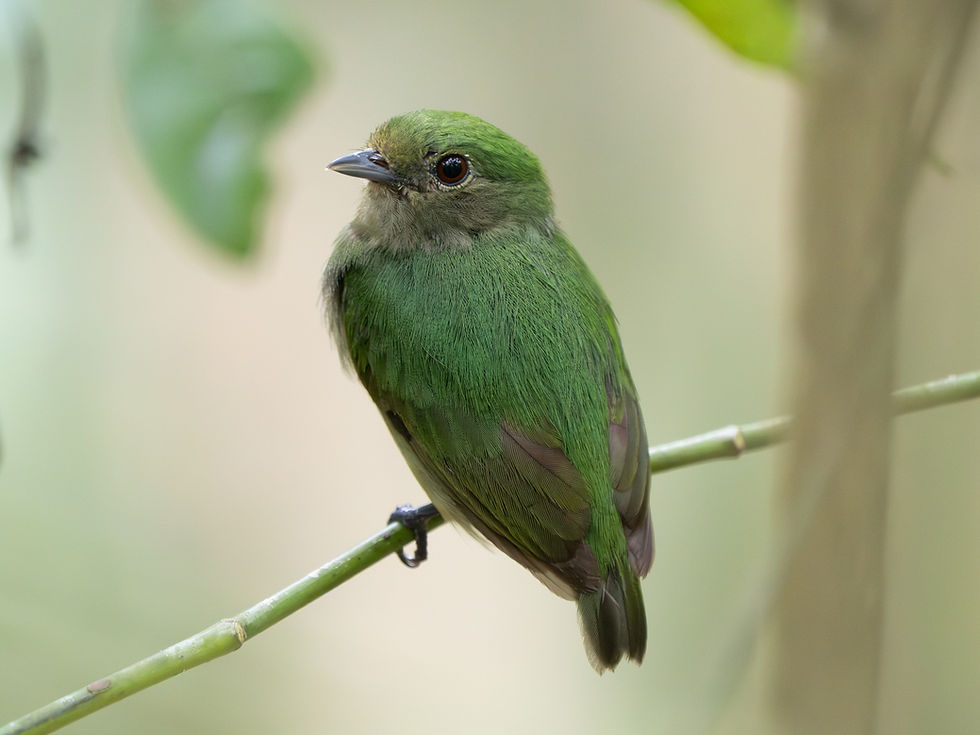
We’d lingered longer than intended, we had a boat to catch, so we retraced our steps to the car, fortuitously picking up a Velvety Manakin on route. As we headed back along Pipeline Road, Rafa picked up a distinctive signature song and we piled out of the vehicle, scanning the vegetation for another wren, this time a Song Wren, it flitted in the gloom of the dense vegetation, but lingered just long enough for both to get a few useable images. Pipeline Road never disappoints, just a shame we didn’t have longer to spend there.
Song Wren Song Wren Song Wren
We picked up our boat in Gamboa, the dock area was to home to a noisy family group of Yellow-headed Caracara. We climbed aboard and set off into the Chagres River system. The forested edges were full of birds, with various tanagers, flycatchers and woodpeckers showing well, if a little distantly. Of the passerines only a Crimson-backed Tanager and a Cocoa Woodcreeper were close enough for a passable image. In contrast an American Purple Gallinule was so close it was hard to keep it in the frame from our the gently bobbing boat.
Yellow-headed Caracara Cocoa Woodcreeper Red-crowned Woodpecker American Purple Gallinule
A little further along, as we were looking for kingfishers, we were somewhat surprised to find a Peregrine Falcon sat on a limb overhanging the river. It seemed entirely indifferent to our presence. We did eventually find a Ringed Kingfisher, which by contrast was rather skittish, as was the ghostly Grey-lined Hawk, which took flight just as we were getting in range for some decent photos.
Peregrine Falcon Ringed Kingfisher Grey-lined Hawk
Our next stop was over 7km along the canal section, to an area of flooded islands just short of Gatun Lake. Many of the guests aboard Borealis had also visited this location on ship organised excursions. We had a few hoped-for targets here and a Limpkin duly obliged.
Northbound migrants were in evidence and a flock of 35 Eastern Kingbirds, destined for North America, sat atop a sparsely leafed tree as just one example. There were plenty of local birds around too including Anhinga, Little Blue Heron and Mangrove Swallow.
Anhinga Little Blue Heron Mangrove Swallow
There were also mammals to be seen, a tiny monkey in the shape of Geoffroy’s Tamarin and two groups of Sharp-nosed Bat, curiously lined up beneath a bromeliad.
Geoffroy's Tamarin Sharp-nosed Bat
Our primary target here was Snail Kite. Hitherto Jeff had considered himself something of Snail Kite repellent, having only seem them at extreme distance from the deck of a cruise ship passing through the canal. His luck was about to change.
Snail Kite Snail Kite
The Snail Kite is a truly specialised raptor, most of its prey consists of Apple Snails, that it extracts from the shell with its winkle-picker bill. We soon found a bird hunting slowly over the marshy margins in classic pose with head-down and legs slightly dangling, ready to pluck a snail from the watery vegetation.
We saw several different individuals well, most were showing some degree of immaturity, but our closest encounter came with a sub-adult male. He was perched on a low emergent shrub, our boat driver approached with delicate precision, the bird remained unruffled, eventually we were so close you could see every barb on every wing feather and gaze deep into its blood red eyes. A sensationally intimate encounter seared deep into the memory.
Snail Kite Snail Kite
Our journey back to the dock was quiet, apart from an Osprey which circled us a couple of times.
Osprey Kettle of Black and Turkey Vultures
We reached the dock as the sun plunged for the horizon; large kettles of Turkey and Black Vultures were spiralling into the surrounding forest to roost. We headed back to Borealis, via a failed bid for Striped Owl in a Panama City park. It mattered not, it had been a great day’s birding with our guide Rafa, in the fabulous forests of Panama.


What a fabulous account of an excellent day out! Thanks again for detailed information and glorious photos; it will be invaluable, should we ever get the opportunity to return.