

S2603 Exploration of South America and the Antarctic - Leg 1, Southampton, England to Buenos Aires, Argentina
- pmh0606617
- May 1
- 22 min read
28th – 30th January 2026 – Southampton
A big cruise to start the 2026 cruising season for Ocean Wildlife Encounters, the South America and Antarctica round trip, titled “A Grand Voyage”, filled the OWE team with great expectations for a fantastic wildlife filled route! However, it didn’t quite start as planned!! But spoiler alert – it did get much better!!
The first of five OWE teams of two to relay throughout the cruise, Christine Murdie and Clare Gower, boarded Borealis with the passengers and crew in Southampton on the 28th January, due to sail later that day. But mother nature had other ideas! Due to Storm Chandra, with Force 10 winds and up to 10m swell, MS Borealis was firmly confined to quarters in Southampton until a suitable weather window arrived for her to finally set sail. So for the OWE team on board, this meant wildlife watching around the docks of Southampton for 2 days.

The first and second OWE talks of the cruise were given by Christine whilst still in dock in Southampton. The first talk introduced passengers to the OWE team, how we work, where to find us and what we hope to see; and the second talk was about The Life of the Humpback Whale. Both talks were very well attended, and captured the interest of many intrigued passengers.
The wildlife sightings list for these first few days in dock was a bit limited, but beautiful eye level views of the numerous Herring Gulls, and some passing Cormorants already gaining their breeding plumage kept us entertained. Then just dosing ourselves up on sea sickness tablets, and getting ready for the “slightly (extremely) rough” conditions for the real start of our epic adventure!
30th January – 3rd February 2026 – Southampton to Gran Canaria
We finally set sail!! Woohoo!! A slight weather window between two prevailing storms gave the captain a very brief opportunity to get the astonishing (as he puts it) Borealis finally on her way to Antarctica. The delay in setting off has sadly meant dropping two of the ports, La Coruna in Spain on the 30th January, and Praia in Cape Verde on the 5th February. So the first stop is now Las Palmas in the Canary Islands.
Sailing out of Southampton docks and the Solent, gave us the first marine mammal of the trip, an Atlantic Grey Seal, seen by a few of the passengers. There were also good numbers of a variety of common UK coastal birds, especially gulls, with a few additional highlights including a Little Gull, several Kittiwake, Gannet, a Razorbill, Guillemot, Oystercatcher, several Brent Geese and a Red-throated Diver.
From leaving the calm safety of the Solent, Borealis instantly hit some quite savage waters after turning the corner from the Isle of Wight, which continued until the early morning of the 1st of February, with up to Force 8 winds, and an 8m swell. This sadly meant that all outer decks of the ship were closed, there was limited visibility due to the height of the waves, and the majority of the passengers and crew(!) suffered from quite severe sea sickness. The limited viewing opportunities and visibility across the Bay of Biscay on the 31st resulted in a meagre list of three Common Dolphins, and five species of birds: Gannets, Kittiwakes, Lesser Black-backed Gulls, Common Tern and Puffin.
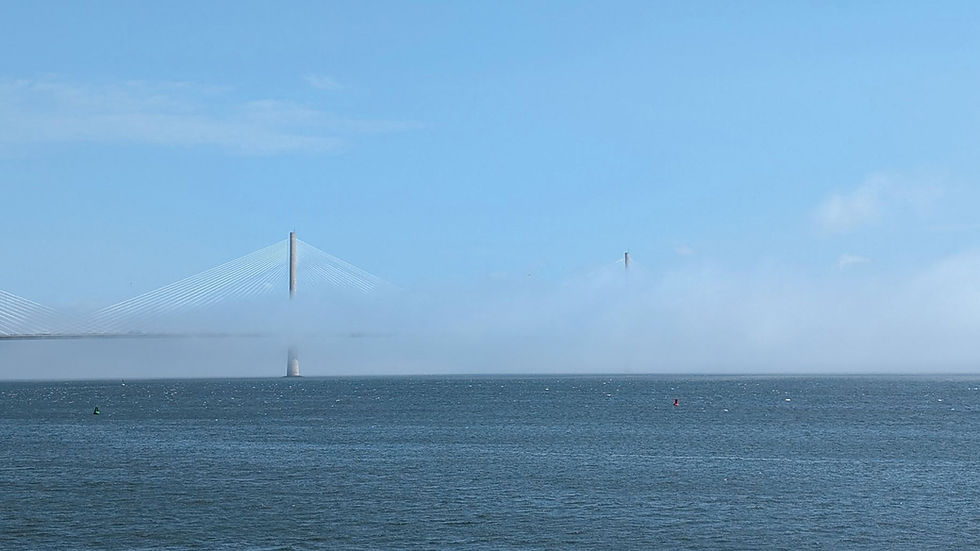
The 1st February finally gave us some access to a few outer decks with some slightly calmer conditions as we sailed down the coast of Portugal, though our favoured Deck 6 was still closed. But it also brought us some thick banks of sea fog, which yet again, hampered our visibility to see any wildlife. However, we did manage to see a couple more Common Dolphins, and a few Gannets and Kittiwakes.
This reprieve sadly didn’t last long, as on the morning of the 2nd of February as we sailed to the west of the Straits of Gibraltar, all outer decks were closed again with another deterioration in the sea conditions, and all observers on board managed between them a dismal sightings list of only two species all day – Kittiwakes (17) and Gannets (2)!!!
As we approached Gran Canaria on the 3rd February, the weather, sea conditions and wildlife sightings all started to improve. We had a few new bird species to add to the list for the trip, such as Leach’s Storm Petrel, Cory’s Shearwater, Yellow-legged Gull and Sandwich Tern, and as well as a couple of common dolphin and a Lion’s Mane Jellyfish, we also finally saw some whales!! Woohoo! We saw a couple each of Fin and Humpback Whales, and a single unidentified beaked whale species. All the species recorded on this day, we could potentially have seen earlier in the trip, had the weather and conditions been kinder to us.




3rd - 4th February 2026 – Gran Canaria
An overnight stop in Gran Canaria gave the OWE team a chance to explore the dock area and a couple of local parks. The dock areas were scattered with a few groups of gulls, dominated by Yellow-legged Gulls, with a few Black-headed Gulls, and a handful of Sandwich Terns were seen fishing around the docks.
Upon walking out of the port, some small urban parks provided a nice selection of birds, some of which were very familiar, such as Blackbird, Robin, Bluetit, Collared Dove, Common Chiffchaff, House Sparrow and the now widespread Rose-ringed Parakeet. However, there were a few local specialities seen such as Spanish Sparrow, and the endemic Canary Islands Chiffchaff and Canary Isle Canary, plus a stunning little leucistic warbler of some sort, the true species of which has stumped the hive mind and extensive book collection of the wider OWE team – after many potential candidate species were debated! It will remain a very pretty mystery species!
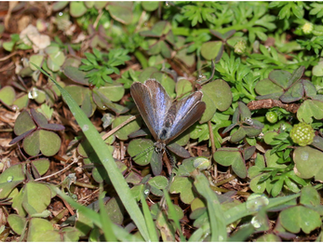
It was not only birds that took the limelight in Gran Canaria. There was also a supporting cast of other lovely beasties, including Gran Canaria Giant Lizard, Red Rock Crab, a large red potter wasp called Delta dimidiatipenne, and several lepidoptera such as African Grass Blue butterfly, Monarch butterfly, Clouded Yellow butterfly and Hummingbird Hawk Moth.




4th – 11th February 2026 – Gran Canaria to Salvador
At 6pm on the 4th, after a half hour extra wait for the tug boats to park a large container ship, Borealis left the docks at Gran Canaria with an entourage of flying fish emerging from under the bow as Borealis negotiated her way out of the harbour and back out into the Atlantic. As dusk fell, a lone Kestrel crossed over the bow, seeming to be heading from sea to land with purpose, and bringing a wildlife filled day to an end.
The crossing of the Atlantic beyond Gran Canaria finally brought some calmer waters, and a hope of more wildlife sightings. We were first heading in the direction of Cape Verde, though now not stopping there, just sailing past.
The morning of the 5th February started brilliantly, with a pod of 12 Striped Dolphins at the crack of dawn, bow riding alongside the ship. These were quickly followed by several sightings of Humpback Whales and more Striped Dolphins, whilst most passengers were still tucked up in their cosy beds! However, the whales and dolphins continued to appear throughout the day, including some distant Spinner Dolphins and a Blue Whale, identified by its enormous columnar blow which hung in the air for some time before dissipating. Along with a similar selection of seabirds to the previous sea days, an eagle-eyed passenger spotted a Grey Phalarope amongst a small group of Leach’s Storm Petrels. Other species spotted included Portuguese Man o’ War, Barrel Jellyfish, Tuna species, the regular bursts of flying fish emerging from under the ship and a stowaway Hummingbird Hawkmoth on board.
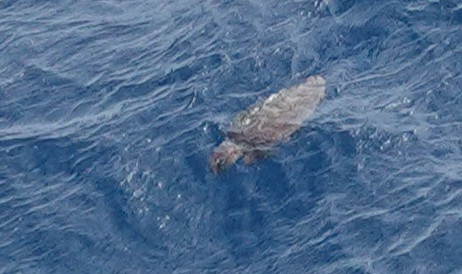
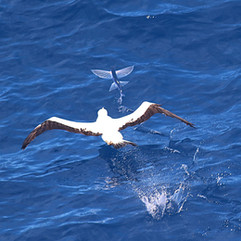
On the 6th February, we were hopeful after yesterday’s start to the day, but we were over much deeper water now, so cetacean sightings were limited to a few Common Dolphin, one distant unidentified whale blow and 15 Atlantic Spotted Dolphin – a new species for trip. We did also see a few other new species for the trip, including a Hammerhead Shark, 3 Loggerhead Turtles, White-faced Storm Petrel, Band-rumped Storm Petrel, a Red-billed Tropicbird and our first Boobies of the trip – 2 Brown Boobies, though even the bird numbers were limited today. The real stars of the show today were the thousands of flying fish, of numerous species, sizes and colours, flying in sometimes huge shoals, out from under Borealis as she cut through the water. These were the main attraction for the boobies, who were very adept at snatching them from the surface of the water.
As night on the 6th, a couple of passengers found a grounded Cape Verde Storm Petrel on deck 3, which was safely released back to sea. A fantastic new species tick for today’s list!
The 7th February was a quiet day for wildlife sightings (apart from flying fish in their thousands!), as we sailed around Cape Verde and headed out across the Atlantic towards South America. The only cetaceans recorded were 8 Atlantic Spotted Dolphins seen by some passengers during OWE’s brief break for some food – always the way! Only a handful of birds were seen throughout the day, including Cory’s Shearwater, Leach’s Storm Petrel, Bulwer’s Petrel (new for the trip), other unidentified petrel species, Red-billed Tropicbird and our 2 Brown Boobies still accompanying the ship.
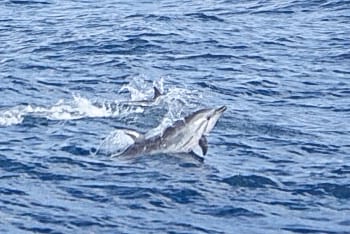


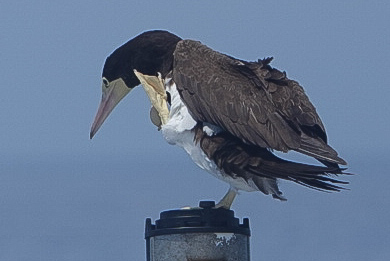


The 8th February also brought limited sighting, but we are now, again, over some very deep water, and will be for most of the crossing of the Atlantic Ocean, with the exception of when we cross the mid-Atlantic ridge. The deeper water usually has fewer sightings of cetaceans, due to the limited feeding opportunities, so we knew we could be in for some more tedious days with little to see. The only cetaceans for the day were 4 Spinner Dolphins, but they are a lovely species to see, with their large splashes as they perform their aerial acrobatics! Again, only a handful of birds were seen throughout the day including a Band-rumped Petrel, and Leach’s Storm Petrel, Cory’s Shearwater, a Brown Booby, and then all excitement for a new species for the trip – 2 Red-footed Boobies!!
At 3am on the 9th February, we crossed the Equator. As nobody was awake at the time, apart hopefully from the crew steering the ship(!), the obligatory “King Neptune’s Court” and the “Kissing the Fish” ceremony was scheduled for later in the day. This ceremony is for any crew who have not previously sailed across the equator, and the senior crew including the very obliging Captain Michael, to kiss the fish and face the judgement of King Neptune, as to whether he will allow them to continue their journey across the high seas, or succumb to their watery demise in the great depths of the Atlantic. It was all great fun, and ended up with everyone, including the Captain, in the pool!

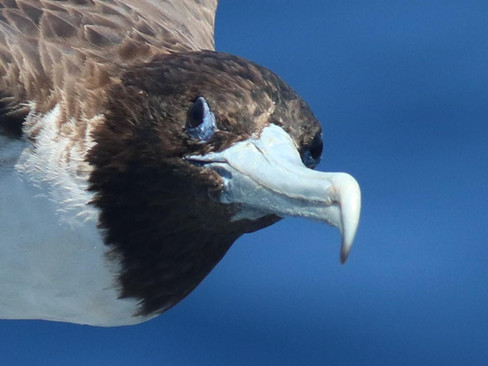


Wildlife-wise, the day was equally as entertaining. A day full of exciting wildlife sightings, starting early-doors with a huge pod of around 100 Pantropical Spotted Dolphins surrounding the ship. The day was also notable for the arrival of Magnificent Frigatebirds, who were sinisterly hanging in the air above the boat, watching for opportune moments to attack the hardworking Brown, Red-footed and Masked Boobies to relieve them of their flying fish meals. This spectacle was highly entertaining, with everyone on board rooting for the poor persecuted Boobies, and yet in awe of the magnificence, size, grace and evil genius of the Frigatebirds. It was all wonderful to watch.
A few Leach’s Storm Petrel, Bulwer’s Petrel, Band-rumped Petrel, Cory’s Shearwater were scattered throughout the day, skimming the sea’s surface, and 2 individual Red-billed Tropicbirds were spotted crossing the ocean. And in the afternoon, a long stream of about 50 Sooty Tern were observed flying east to west across the bow, and later a large feeding flock of about 40 Brown Noddy were seen off the portside of Borealis. It was a great, long awaited wildlife day!
The 10th February was spent approaching and then sailing down the coast of north-eastern Brazil, towards Salvador. It did not quite meet the dizzying heights of the wildlife spectacles of the previous day, but the Boobies and Frigatebirds still gave us quite a show to keep us entertained. A new species for the trip was 5 Manx Shearwater, and we also saw 3 Cory’s Shearwater and 1 Band-rumped Storm Petrel. It wasn’t close to the numbers of birds yesterday, but there were still huge numbers of flying fish, and we saw a small pod of five Pantropical Spotted Dolphin, and then another new species for the trip – a stunning Flying Squid!



11th February 2026 – Salvador
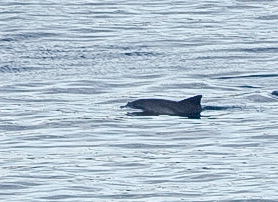
We docked in Salvador whilst it was still dark, but over breakfast at the back of deck 8, a small pod of five dolphins were spotted feeding within the harbour walls. Checking the photos later, the excitement was raised as it was discovered they were Rough-toothed Dolphins, a speciality of the area.
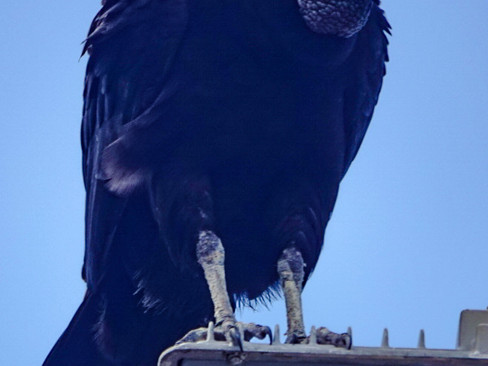
Salvador proved to be a great place for wildlife, even within the city, with Crested Caracara’s, Black and Turkey Vultures flying overhead; White-winged Swallows flying around the port; Great Kiskadees, House Sparrows, Common Ground Doves and Scaled Doves calling from phone and electricity wires; and Plain Parakeets flying noisily from tree to tree.


Clare set off early doors on a Fred Olsen organised trip to see a turtle conservation centre, Projeto Tamar, in Praia do Forte, followed by lunch at a local restaurant and a visit to a local beach in Guarajuba. The journey to the Projeto Tamar went through the city and it’s suburbs, and out into the countryside to the north of Salvador, passing through several wetland areas. The suburbs of Salvador had some extreme contrasts of the ramshackle slum areas, where the precarious houses are piled on top of each other, with many rough sleepers and stray dogs, compared to some very high-end gated estates, where people can buy a plot of land, and build their own design of mansion. The artistic South American flare is evident everywhere, with some incredible sculptures, murals and street art along every road. The public artistic creativity and talent here puts the boring streets of Britain to shame, and is an absolute joy to see!
During the drive, several new species were spotted, including many Southern Lapwing on the grassy verges along the roadsides and central reservations; a Roadside Hawk gliding over the coach; and an American Kestrel hovering over some rough grassland. There was an obvious huge thermal with at least 100 vultures, mostly Black Vultures with a few Turkey Vultures, circling up within it to a dizzying height. As we passed a wetland near to our destination, a Green Kingfisher was spotted scanning the water from it’s perch on a wooden jetty.



The Projeto Tamar turtle conservation centre was a good opportunity to see all five locally found turtle species (Loggerhead, Green, Leatherback, Olive Ridley and Hawksbill Turtles), and a few other marine species of Rays, Fish and Sharks, up close. But it did have the feel of being more of a tourist attraction than a sanctuary and rehabilitation centre, with very clinical, uninspiring and unstimulating tanks, with no vegetation or shelter from the viewing public.
However the walk to and from the Projeto Tamar Centre, through the tree lined streets of Guarajuba, with flowering bushes and climbers decorating the properties along the street, brought a host of bird and invertebrate sightings, including Bananaquit, Blue-gray Tanager, Palm Tanager, Sayaca Tanager, Rufous-browed Peppershrike, Great Kiskadee, Rufous Hornero, Tropical Kingbird, an unidentified hummingbird species silhouetted against the sky, zipping around the tree tops, Cloudless Sulphur butterflies and White Peacock butterflies fluttering between the flowers, and Red Saddlebag dragonflies patrolling the streets. The small fishing boats moored near the beach were providing roosting perches for over 50 Common Terns.
After a local speciality lunch of a Brazilian fish stew at the restaurant in Guarajuba, instead of going to the beach Clare and a couple of passengers headed back down the entrance road to a wetland area that was passed on the drive in. This area was a very productive area for wildlife.
One of the first birds seen was a huge and impressive Snail Kite sitting amongst the reeds, then making frequent hunting flights across the wetlands and landing amongst the vegetation. Two Limpkins were observed, one of which was sitting, bathing in the water, whilst the other was feeding in the shallows, occasionally making short flights to new feeding areas. A couple of Wattled Jacana including a juvenile mooched through the vegetation, Brown-chested Martins swooped over the water and Snowy Egrets fished around the wetland edges.
A rustle in the adjacent trees drew our attention, and was caused by a small family troop of Marmoset monkeys, including a very small, young one who was venturing out independently from its parents. But they were then disturbed by an incredibly raucus flock of Guinea Fowl, possibly domestic, who were blatantly shouting at us for daring to be in their feeding area! So we backed off to stand nearer to the road, and watched several smaller birds flitting and hopping around in the bushes, grassland and taller vegetation, including Masked Water Tyrant, Pale-breasted Thrush, Saffron Finch, Tropical Mockingbird, Rufous Hornero, Common Waxbill and a Chalk-browed Mockingbird, whilst a marauding gang of Shiny Cowbirds randomly harassed different smaller birds. A well hidden Southern House Wren started to serenade us just as we had to leave for the coach back.
As we sailed away from Salvador harbour, we were quickly reunited with an accompanying Brown Booby taking advantage of the bountiful flying fish again.


12th – 13th February 2026 – Salvador to Rio de Janeiro
Some squally and heavy showers on the 12th meant that deck 6 was closed, so deck 3 starboard was our viewing platform for the morning. A very distant large pod of dolphins were spotted near the horizon, but sadly didn’t come any closer, and disappeared into the ether. After the rain had passed, deck 6 was reopened and the rest of the day was spent up there. The ship was now being accompanied by large number of Masked and Brown Boobies, totalling at least 79, with just one juvenile Frigatebird. A single Cory’s Shearwater was the only other seabird seen, but huge streams of a brown organism, possibly a Phytoplankton or Autotroph, covering many miles were observed throughout the day.
The 13th February was an extremely hot and humid day, meaning the limited shade at the sides of deck 6 were much sought after by a surprisingly large number of brave observers, though the rewards for sticking out the heat were great as everyone on deck saw at least one of the 4 Hammerhead Sharks that swam very close to the ship. These were closely followed by a Black Tip Shark, a Ray species, a Hawksbill Turtle, another unidentified Turtle species, 27 Pantropical Spotted Dolphin and a couple of unidentified dolphins. The shallower waters and reefs on the approach to Rio were proving very productive!
As well as the now usual accompanying Masked and Brown Boobies and a couple of Frigatebirds, on the open ocean we also saw a Manx Shearwater, a Brown Skua and an Arctic Skua mugging the Boobies, and a Red-billed Tropicbird.





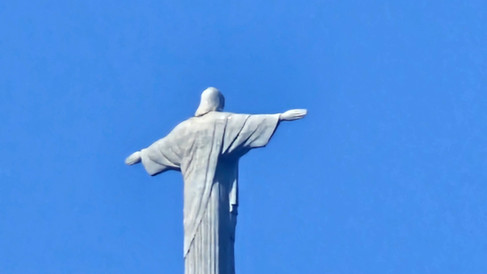
As we entered Guanabara Bay on the approach to Rio de Janeiro, the Forecast on Deck 4 and the front of Deck 6 completely filled up with passengers wanting to see the iconic scenery of Rio, including Christ the Redeemer and Sugarloaf Mountain. It was incredibly impressive! Awesome in fact!!
As Borealis entered the narrows into Guanabara Bay, an American Oystercatcher and some Kelp Gulls were spotted on a rocky outcrop under some old fortifications, and over 100 Magnificent Frigatebirds and Black Vultures were seen riding thermals towering up from the mountainous landscape all around. However, the best sighting of all, in fact of the entire cruise so far, was when sailing though the bay towards our moorings, a few of us had a very brief view of some pale coloured dorsal fins, only emerging from the water about 3 times before disappearing for good - a small pod of 4 Guiana Dolphins! A real rarity! The Guiana Dolphin (Sotalia guianensis), also known as the Estuarine Dolphin or Costero, is a dolphin found only in the coastal and estuarine waters to the north and east of South America, and east of Central America.
Their population has declined throughout their range in recent years, and in Guanabara Bay alone, it has decreased from 400 individuals in 1985 to below 30 in 2024, and while populations in Sepetiba Bay and Ilha Grande Bay to the west are larger, they are also thought to be at risk (data taken from Wikipedia). Species that only occur in very specific areas and/or habitats are more at risk to changes in their environment, such as pollution, which is a known issue in Guanabara Bay. They are also at risk of certain fishing methods, such as gillnet fishing, which is illegal, but still happens. So, we were extremely lucky to see them!
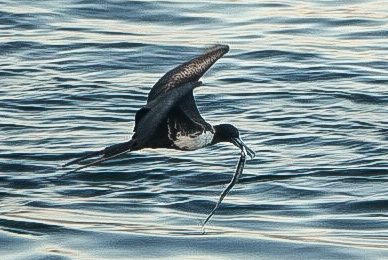
Whilst docking in the harbour, several Magnificent Frigatebirds and a couple of Great Egrets took advantage of the ships thrusters churning up some fish of all sizes including some quite large Atlantic Cutlassfish (Trichiurus lepturus), of which they, quite unusually for both species, would swoop down to pick them out of the water whilst still on the wing. They were obviously very well practised in this fishing technique and were very successful. There were also many Neotropic Cormorants and Brown Boobies distributed around the Bay, a few Kelp Gulls on the dockside, Great Kiskadees singing from the city side of the harbour and several Blue and White Swallows swooping around the docks.


13th – 15th February 2026 – Rio de Janeiro
The two night stopover in Rio de Janeiro coincided with Carnival time. The city was alive with music, samba, extravagant outfits and incredible floats. Most passengers opted for going to enjoy the festivities and soak up the joyous atmosphere of the Carnival, whilst the OWE team, true to form, opted for discovering the incredible wildlife of Brazil. Both Clare and Christine each went to explore the Rio de Janeiro Botanical Garden, and Clare also ventured to the Tijuca Forest for a jeep tour.
The Botanical Gardens, which are situated within the Jardim Botânico district in the South Zone of Rio de Janeiro city, and are adjacent to the Tijuca Forest, were brimming with wildlife, with exotic calls and noises filling the air. One of the first sights were a few small Marmoset monkeys bounding across the ground between trees, stopping to munch on fallen seeds and unsuspecting invertebrates on the way. Hopping around within the grassland, lower vegetation and shrubs were Saffron Finches, Rufus-breasted Thrush, Rufous-collared Sparrow, Purple-throated Euphonia, Chalk-browed Mockingbird, Ruddy Ground Dove and Southern House Wren. The mid to upper canopies of the shrubs and trees had a different selection of species which included Bananaquit; Palm and Sayaca Tanagers; Tropical Kingbirds; Jandaya, Plain and White-eyed Parakeets; Great Kiskadee; Olivaceous Woodcreeper; Southern Beardless Tyrannulet; Common Tody-flycatcher and Blue-winged Macaw.
A large pond within the gardens, was a popular drinking spot for several species, including several Tropical Kingbirds and Southern Rough-winged Swallow. The edge of the Botanical Gardens that was adjacent to the Tijuca Forest, provided a few extra specialities including Capuchin monkeys, Dusky-legged and Rusty-margined Guans, and a White-bearded Manakin. Towards the end of the visit, a couple of Channel-billed Toucan were spotted flying through the gardens, and Clare was lucky enough to see them (at a discreet distance) coming in and out of a nest hole in a tree.


Clare’s other trip in Rio was on a Fred Olsen organised trip in an open top Jeep to the Tijuca Forest. Travelling through the streets of Rio in an open top vehicle during Carnival was an exhilarating experience! The colours, sounds, extravagant costumes and floats, and the wonderful party atmosphere were absolutely joyous! What a fabulous city!
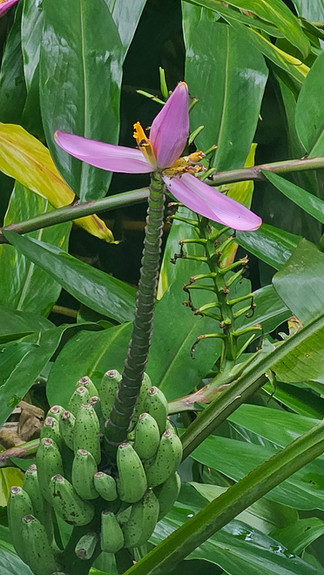
The first stop of the tour was to see a beautiful waterfall within the forest. The waterfall was framed beautifully by the variety of foliage the of the forest, including Clare’s first encounter of flowering Banana plants. These were obviously a good nectar source within the forest as they were all covered in a host of insect life. On returning to the Jeep from this stop, there was much excitement within the car park due to a family group of Capuchin monkeys travelling through the canopy, quizzingly looking at those strange humans gazing up at them from the forest floor.
The next stop included a short walk through the forest to the visitors centre, and then on to our picnic area. Birds within the forest were often hard to spot due to the dense foliage, but many were heard, with a cacophony of bird song and forest noises all around. Alongside the narrow track through the forest were a pair of Yellow-olive Flatbill (a.k.a. Yellow-olive Flycatcher) flitting about in the shrubbery with a high-pitch call. Other small birds were hard to spot, but fleeting glimpses of species such as Gray-headed Tody-flycatcher, Golden-crowned Warbler, Lesser Woodcreeper and a couple of unidentified Hummingbird species added to the day list. Several large Channel-billed Toucan were seen in the higher canopies of the forest, throwing various fruits picked from the trees into the back of their throats. A few more Capuchin and some Marmoset monkeys were spotted jumping around within the mid to higher levels of the forest.
The invertebrates of the forest also added to the experience including (amongst many, many other species) large Army Ants and Golden Carpenter Ants marching across the forest floor and up the trees; beautiful lepidoptera including the stunning Melinaea ludovica and Morph butterflies, and a Dead-leaf Moth; a leaf-footed bug called Grammopoecilus angustatus sitting on an interpretation board; and a huge Golden Silk Orb-weaver spider proudly sitting within a huge web edging a pond near the picnic area. In addition to the incredible variety of animals and plants seen, a stunning coral fungus species was found in the undergrowth surrounding the picnic area. The variety of species within the forest was incredible! Though maybe not for the arachnophobe!
Late in the day on the 15th, we set sail from Rio towards the beautiful isle of Ilhabella.






16th February 2026 – Ilhabela
Early morning of the 16th February, at dawn, we approached the stunning island of Ilhabela, within the State of Sao Paulo. The dramatic green mountains and hills of Ilhabela, with the glowing sun rising from behind them, was a fitting introduction to this beautiful island.
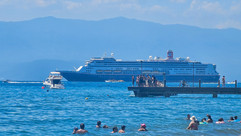
The Borealis docked offshore between Ihabella and the Sao Sebastiao area of mainland Brazil, and tenders took passengers across to the island. Numerous Pipefish were seen from the shoreline of Ilabella, and Green and Hawksbill Turtles were observed at close quarters, even swimming amongst boats and bathers along the beaches.
A 1.2 mile walk southwards along the coast to the Parque Municipal Farenza Engenho D’aqua, in a baking hot 36oC (!) was interspersed with a number of Saffron Finches, Tropical Kingbirds, Bananaquits, Great Kiskadee, Blue-gray Tanagers and Palm Tanagers, as pauses were taken under the occasional trees for a shady break, scouring the surrounds with binoculars for wildlife.
Upon entering through the blue gates of the Parque Municipal Farenza Engenho D’aqua, several Picazuro Pigeons were feeding and resting on the ground in the shade of the trees, with a few others in the higher tree canopies edging the large front lawn. A few Southern Lapwing were also feeding on the extensive mown lawn, taking advantage of the softer ground and insect life emerging in the areas where the sprinklers had been.
As the heat of the midday sun hit, the open areas were now quiet of bird song, so a shady spot to sit on a large rock was found, and it was a case of sitting quietly to see what emerged. This proved to be a highly productive tactic, as quite quickly, wildlife emerged from the surrounding habitats and came to feed within the shade. Ruddy Ground Dove, Saffron Finch, Rufous-collared Sparrow and Purple-throated Euphonia all mooched around in the ground vegetation. Bananaquit, Palm Tanager, Blue-gray Tanager, Rufous-margined Antwren, Social Flycatcher, Tropical Parula, Sayaca Tanager, Southern House Wren and Southern Beardless-tyrannulet all flitted about in the mid-canopies of the shrubs and trees. Maroon-bellied and Plain Parakeets squawked and screeched noisily as small flocks of them zoomed around over the tallest canopies. Then a dark hummingbird, a Black Jacobin, was spotted zipping around the trees, feeding on their flowers. To add to the incredible birdlife, a number of beautiful butterflies were seen fluttering through the glades, including Brazilian Skipper, White Peacock, Cloudless Sulphur and Blue Morpho.
On the long hot walk back to the tenders, a short rest to cool off, paddling in the clear waters of the Atlantic, gave an unexpected opportunity to watch the amusing antics of hundreds of isopods along the sea wall tide-line. They were some kind of Wharf Roach species, with stunning jewel like eyes of various colours. They would creep further and further out along walls or steps, then like a flash, shoot back into a crevice when either a wave came or there was another movement nearby. Wonderful to watch!
In the evening, Borealis bade a fond farewell as she sailed away from Ilhabela, marked with a flyby of 5 Neotropic Cormorant and a Snowy Egret. Upon exiting the straits between Ilhabela and mainland Brazil, the captain diverted south a bit to steer around the Alcatazes Archipelago Wildlife Refuge Marine Protected Area. It is the second largest fully marine protected area in Brazil and is located 40 km off the coast of São Paulo, Brazil, comprising of tropical, shallow water, coral reef environments over rocky shores and a sandy/muddy deep-sea bottom. Sadly no sightings from the ship of the wildlife known to reside there.








17th – 19th February 2026 – Ilhabela to Buenos Aires
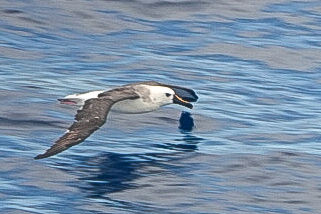
The morning of the 17th started with a large Black Witch moth being spotted near the pool by some guests. A stowaway from Ilhabela. This first sea day on the way to Buenos Aires turned out to be a great day for Albatross! Along with a few Brown Boobies and Cory’s Shearwater, 14 Atlantic Yellow-nosed Albatross were spotted from deck 6 throughout the day, along with a juvenile Black-browed Albatross and a wonderful Salvin’s Albatross!
Salvin's albatross (Thalassarche salvini) is primarily a Pacific and Indian Ocean species, and is considered a rare vagrant in the Atlantic Ocean, and even then it usually only comes up as far as Argentina and Uruguay. So a brilliant sighting and record! However, another exciting sighting was yet to come! Clare spotted a large dark petrel bobbing about on the sea very close to the ship, but after quickly glancing around to shout to other spotters on deck, the bird had vanished. Maybe it was a figment of Clare’s imagination! No wildlife was seen for quite some time after that. But several hours later, a guest approached one of the knowledgeable birders on board with a photograph he had taken on deck 3 at the exact same time as Clare’s mystery petrel, of a bird flying straight down the ships side, asking what type of funny looking booby was this. It was a Spectacled Petrel! A stunning bird and definitely on the bucket list.
There were the usual shoals of flying fish escaping the bow of the ship, but a couple of Portuguese Man o’ War floating past and some shimmering Tarpon just below the surface were fascinating sightings.
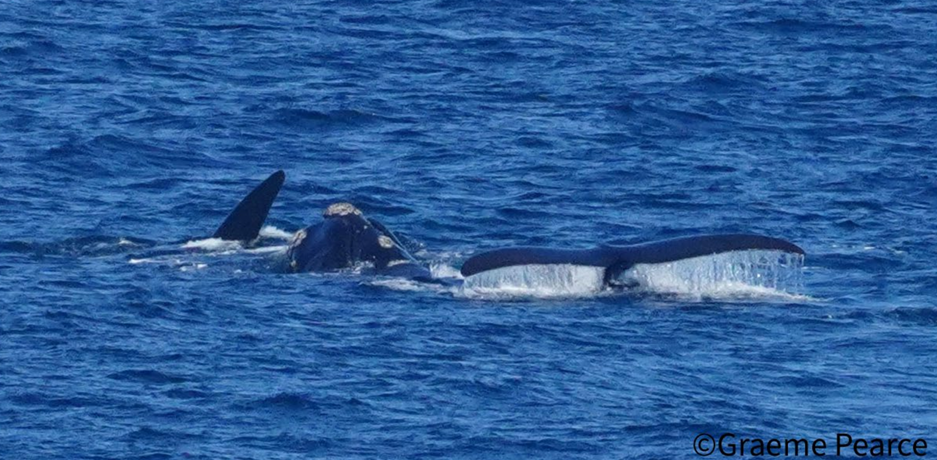
The 18th February was the last day aboard Borealis for the 1st OWE team of Clare and Christine. At first light, a pod of about 12 dolphins could be seen splashing as they porpoised, but too distant and in poor light to identify which species. Then 20 minutes later, a whale blow on the starboard side of the ship – a Bryde’s Whale! A new whale species for the trip on our last day. Several Albatross were seen gliding over the water, including Atlantic Yellow-nosed and Black-browed Albatross. A Cory’s Shearwater, a couple of Manx Shearwater, and three White-chinned Petrel added nicely to the early birders list.
We then gave our final presentation, a round up of all the species seen on this first leg of the trip, to a full house within the Neptune Theatre. We then rushed straight to a hosted lunch with a lovely group of interested guests. However, the 3 hours we were away from deck proved to be possibly the best 3 hours of wildlife of the trip so far – and we missed it. The curse of the Wildlife Speaker! But many of the usual wildlife spotting guests did see it, and gave us wonderful descriptions of the wildlife spectacles they had seen. It included around 200+ Pantropical Spotted Dolphin and about 60 South American Fur Seals all porpoising and playing around the ship for a prolonged period, two more Bryde’s Whales, and four Leatherback Turtle! They had amazing views, and some incredible photographs. Yes, we were of course a bit jealous, but absolutely delighted for all the excited, lovely guests who got to see this very special wildlife spectacle!
Back on deck 6, as we approached the entrance into the Rio de la Plata, between Uruguay and Argentina, about 30 South American Fur Seals were spotted hauled out on a rocky outcrop on the east side of Isla de Lobos. Isla de Lobos translates as Sea Wolf Island, which usually refers to Sea Lions, but could equally refer to Fur Seals. Isla de Lobos is home to one of the largest colonies of South American fur seals (250,000+) and South American sea lions (1,500+) in the Southern Hemisphere. There was likely many more Fur Seals and Sea Lions on the Island, though their favoured beach on the north side of the island was out of view.
The last birds seen as the sun set on our final day, approaching Buenos Aires were 3 Kelp Gulls and a Tern. We had a wonderful time on this cruise, meeting many fantastic people, and seeing lots of incredible wildlife and places. It will be unforgettable! We wish all the guests and crew of Borealis a fantastic onward journey.
Due to a general strike in Argentina, OWE’s Team 2 of Anno and Mikey, couldn’t get to Buenos Aires, so met up with Borealis at her next stop in Montevideo, Uruguay. The Grand Voyage continues…

Comments