

S2618 – Picturesque Lochs & Isles of Scotland 24 July-3 August 2026
*All photos in this blog were taken on the cruise and were taken by Peter Howlett unless otherwise stated
The team’s timing was immaculate, Paul Hill, Julia Mottishaw and Peter Howlett arrived at the bag drop at the City cruise terminal, Southampton, at exactly the same time. We couldn’t have planned it if we’d tried. Check in and boarding was very swift and we were on board Borealis and in our cabins within 30-40 minutes of arriving at the port.

Sail away was at 17:00 and we were able to be on deck in shorts and t-shirts, probably not something that we’ll be doing when we’re further north where the forecast was suggesting temperatures would be in the mid-teens over the next few days. There were plenty of birds to be seen as we sailed down the Hamble and into the Solent, with Black-headed Gull, Herring Gull and Common Tern the most common, with some feeding flocks of 2-300 birds. Sandwich Tern, Mediterranean Gull and Great Black-backed Gull were also seen in smaller numbers in the Hamble.
Great Black-backed Gull (Peter Howlett/OWE) Herring Gull (Peter Howlett/OWE) Black-headed Gull (Peter Howlett/OWE) Common Tern (Peter Howlett/OWE) Juvenile Common Tern (Peter Howlett/OWE) Sandwich Tern (Peter Howlett/OWE) Mediterranean Gull (Peter Howlett/OWE) Mediterranean Gull (Peter Howlett/OWE)
However, once out past the Nab tower there was a dramatic increase in Mediterranean Gull numbers with around 200 seen. There is a swift and dramatic westward post-breeding movement by these gulls. For example, there is a recent record of a juvenile from eastern Germany reaching Wales in a little over a week. Adults and non-breeding birds move as well and large numbers can be seen in the southern half of the UK.
The Hamble and Solent are always interesting places to sail through, aside from the wildlife there’s lots to look at and the number of pleasure boats must make it a nightmare for the masters of large vessels like Borealis. In places the banks are littered with the hulks of derelict barges, now firmly embedded in the sand and mud.
The last few years has seen an increase in the number of cargo vessels sporting rigid sails of one variety or another. Presumably, saving up to several tonnes of fuel a day, if conditions are right, is seen as worthwhile. We passed the brand new oil tanker Monza discharging her cargo at the Fawley terminal and her folded sails were clearly visible.
Derelict barge (Peter Howlett/OWE) Tanker Monza (note folded rigid sails) (Peter Howlett/OWE) No Man's Land Fort (Peter Howlett/OWE) Horse Bank Fort (Peter Howlett/OWE)
The Solent forts are a prominent feature and are in varying states of preservation but always fascinating to see up close. We passed close by No Man’s Land fort which was converted into luxury accommodation but is currently closed and a little way off to the east was Horse Sand fort which is derelict. There is also Spitbank fort, closer to Portsmouth, which was also converted into a hotel and also currently closed. Perhaps the market for people wanting to be on a lump of concrete in the Solent, even if your surroundings are luxurious, might be rather limited.
25 July – at sea Straits of Dover-North Sea
At dawn we were passing through the Straits of Dover, with the white cliffs visible in the haze to the north and the skyline of Calais to the south. There was a light north-west breeze and clear skies, a good start to the cruise. The cross-Channel ferries were much in evidence and as they cut across one of the busiest shipping lanes in the world, a task that requires careful planning. We were also overtaken by the AidaSol, a 2100 berth cruise ship sporting the distinctive Aida livery, on her way to Hamburg doing 17 knots compared to our 14.
P&O Liberté (Peter Howlett/OWE) AidaSol (Peter Howlett/OWE)
There were a few birds accompanying us, the north-west breeze was creating a column of air on the port side of Borealis and a few Lesser Black-backed Gull were making good use of it and getting a free ride with us. They were occasionally joined by Gannet, including a smart adult and a 2-3 year old bird.
Lesser Black-backed Gull (Peter Howlett/OWE) Gannet (Peter Howlett/OWE) Adult Gannet (Peter Howlett/OWE) 2-3 year old Gannet (Peter Howlett/OWE)
As we worked our way up the coast of Suffolk and Norfolk (albeit 20-30 miles offshore) we began hearing the plaintive peeping of Guillemot chicks accompanied by the guttural growl of their fathers. This would be a familiar sight and sound for the next few days. The chicks jump off the breeding ledges when they’re about 20 days old. At this age they are just down and the covert feathers are just appearing on their wings. Despite the lack of flight feathers they’re light enough to flutter down to the sea, often having to survive the odd bounce off of rocks on the way down.
Once in the sea their dads take them offshore where they look after them until they’re fully feathered. These birds are likely from the colonies at Bempton or even further north and had paddled something like 200km since fledging.
Adult Guillemot with chick (Peter Howlett/OWE) Fulmar (Peter Howlett/OWE)
Bird numbers remained low and the range of species didn’t change much either, just the odd Fulmar gliding effortlessly past the ship. Despite much searching we couldn’t find a cetacean either.
By late afternoon we were well amongst the main gas fields of the southern North Sea with rigs almost wherever you looked. Many are unmanned pumping stations but there are still plenty that require human attention.

Late in the day a beam trawler crossed our path and was obviously processing a catch as there were 2-3000 gulls, mainly Lesser Black-backed, surrounding it and in the wake. Despite much searching we couldn’t make out any skuas or anything other than Herring, Lesser, and Great Black-backed Gull in the flock.
Beam trawler with large gathering of gulls (Peter Howlett/OWE) Lesser Black-backed Gull (Peter Howlett/OWE) Lesser and Great Black-backed Gull (Peter Howlett/OWE) Herring Gull (Peter Howlett/OWE)
We called time on watching from the decks in early evening, moving up to the Observatory for refreshment before dinner. Despite much searching we ended the day without a cetacean sighting.
26 July – at sea in the North Sea
At dawn we were about 120km east of Hartlepool and would spend the day heading NNW in a straight line towards the Aberdeenshire coast. The wind was a light north-westerly to start but soon freshened to a force five which made life a little difficult trying to pick out cetaceans.
Redshank (Peter Howlett/OWE) Redshank (Peter Howlett/OWE)
Surprise sighting of the day was a flock of three Redshank which flew past us an hour or so after dawn; oddly they were heading north. We also picked up a passenger during the night or soon after dawn – a Sedge Warbler was found skulking amongst the plastic foliage on deck 8. It stayed with us for much of the day but appeared to depart mid-afternoon. There’d been a bit of rain overnight with some low cloud so Borealis had probably been a handy bit of shelter, perhaps a bird setting off from the very north of Scotland.
Sedge Warbler (Peter Howlett/OWE) Sedge Warbler (Peter Howlett/OWE)
Otherwise, birds were a little thin on the ground. We passed plenty of peeping Guillemot and Razorbill chicks – a good sign as it suggests a good breeding season – but there was little else. The odd Fulmar passing by at eye-level kept us entertained and we saw our first Common Gulls and you can never tire of seeing a Gannet.
Razorbill and chick (Peter Howlett/OWE) Guillemot and chick (Peter Howlett/OWE) Fulmar (Peter Howlett/OWE) Common Gull (Peter Howlett/OWE) Gannet (Peter Howlett/OWE) Jersey Tiger (Peter Howlett/OWE)
There was a little insect-related excitement when a passenger found a Jersey Tiger moth on a wall in the lido. If you look at the distribution map for it there are few records north of a line between the Wash and south Wales but there has been a huge influx this year and the map will look very different once all of the 2026 sightings are added. Of course, there is also the possibility that the moth had been on board since we left Southampton!
Sunset at 21:29 was worth nipping back out on deck for.

27 July – Invergordon
Clear skies and a cool westerly breeze greeted us as we sailed down the Moray Firth towards our first port call – Invergordon. We passed several feeding flocks containing hundreds of Kittiwake, Common Tern, Guillemot and Razorbill but despite much searching we could find no cetaceans feeding amongst them.
Kittiwake flock (Peter Howlett/OWE) Cromarty Firth pilot (Peter Howlett/OWE)
We picked up the Cromarty Firth pilot just outside the firth and made our way slowly through the narrow mouth and then past the picturesque town of Cromarty. There was a large raft of 200 hundred or so Common Eider to starboard and off to port a raft of 180 Canada Geese, on the beach 500 Herring Gull and in the background was the constant calling of Common Tern – great to see so much wildlife in such a lovely place. Just as we were pulling alongside, a distant Osprey hunting over the far side of the firth was picked up and a Harbour Seal popped up alongside Borealis, an excellent start to the day.

On the dock an Oystercatcher was busy trying to get into a large mussel, its youngster looking on waiting to be fed. They would soon be disturbed as they were in the middle of the walkway all the passengers would use to exit the port. It was also clear that ship would make a great place to photograph Common Tern later in the day as they were constantly flying to and fro close by the stern.
Common Seal (Peter Howlett/OWE) Oystercatcher and chick (Peter Howlett/OWE) Water off a ducks back - Eider (Peter Howlett/OWE) Common Tern (Peter Howlett/OWE)
A walk along the waterfront was made all the more pleasant by some warm sunshine and a temperature rather more bearable than the south had been experiencing over the past few weeks. Birds were few and far between, the highlight being a couple of Twite (sadly too brief a view for a photo). Just outside the port area and right alongside the road a couple of pairs of Common Gull had nested and both now had almost fledged young inside a small fenced area of waste ground.
Adult Common Gull (Peter Howlett/OWE) Newly fledged Common Gull (Peter Howlett/OWE) Common Tern (Peter Howlett/OWE) Common Tern (Peter Howlett/OWE) Common Tern (Peter Howlett/OWE) Common Tern (Peter Howlett/OWE)
Back on board the team spent an hour or two photographing Common Tern from Borealis as there were a few birds nesting on the harbour office building which kept giving us very good views.
Given the narrow entrance to Cromarty Firth, it was a little surprising to see there were a large number of Moon and Lion’s Mane Jellyfish in the water, the sea surface behind the ship being calm enough to get some photos. Presumably, the currents on the flood tide into the Firth bring them in from the Moray Firth.
Moon Jellyfish (Peter Howlett/OWE) Lion's Mane Jellyfish (Peter Howlett/OWE)
Sail away was 17:00 and it was a lovely evening, sunny with a force four westerly breeze behind us. Into the Moray Firth it was interesting to see that there were still several feeding flocks of Kittiwake, terns and auks. It will certainly make life a lot easier for the Kittiwake that breed on the nearby cliffs at North Sutor, their well grown chicks visible in the colonies. There were no youngsters in amongst the auks so perhaps these were all females, the males having led the chicks out to sea. There were both Arctic and Common Terns in amongst the feeding flocks, with perhaps Arctic outnumbering the Common, the opposite of how it was alongside in Invergordon.
North Sutor Kittiwake colony (Peter Howlett/OWE) Adult Kittiwake (Peter Howlett/OWE) Arctic Tern (Peter Howlett/OWE) Guillemots (Peter Howlett/OWE)
Once again there were no cetaceans seen feeding in amongst all the birds, although one passenger thought they might have seen a Harbour Porpoise. Six days after we passed North Sutor three Northern Bottlenose Whale were seen there!
As we sailed up the Moray Firth the wind dropped and, for a short time, we had a sea state zero – we still couldn’t find a cetacean, only one Grey Seal. However, the scenery was fantastic.
A calm Moray Firth (Peter Howlett/OWE) A calm Moray Firth (Peter Howlett/OWE)
28 July Lerwick, Shetland
The wind was light enough to get out on the forward observation deck for dawn, and it was well worth it. The sea was calming as the wind dropped, and we had a beautiful sunrise and before long we had beautiful light and a sea state zero. Watching Gannet and Fulmar glide past over the mirror-calm, sunlit sea was fantastic – you don’t see it that often, so it really sticks in the memory.
Sunrise (Peter Howlett/OWE) Gannets at sunrise (Peter Howlett/OWE) Sumburgh Head (Peter Howlett/OWE)
With the sea so calm you could see auks from miles away and it was easy to pick out Puffin amongst the Guillemot and Razorbill. We passed Sumburgh Head shortly after 05:00 and continued towards Lerwick. There were hundreds of auks to see but surprisingly few Gannet, given the Noss colony was only a few kilometres away to the north.
Gannet skimming the sea (Peter Howlett/OWE) Guillemots, including one bridled form (Peter Howlett/OWE) Guillemot and chick (Peter Howlett/OWE) Fulmar (Peter Howlett/OWE) Fulmar (Peter Howlett/OWE) Puffin (Peter Howlett/OWE) Risso's Dolphin (Peter Howlett/OWE) Risso's Dolphin (Peter Howlett/OWE)
Given the conditions and a rapidly approaching Lerwick we were beginning to despair at seeing a cetacean, but finally a glimpse of a fin, at least a couple of kilometres north of the ship but very obvious. Photos confirmed the identity as two Risso’s Dolphins, likely a mother and fairly well grown calf. They were on view for for a few minutes before promptly disappearing, although a passenger saw them heading off to the east towards the southern tip of Bressay.
We arrived in Lerwick still with mirror-calm conditions and anchored in Bressay Sound, a few hundred metres from the harbourside. We had only been stationary a short time when Peter spotted the distinctive roll of a Minke Whale between the ship and Lerwick. Typical of a Minke it didn’t immediately reappear but moving to the other side of the ship we glimpsed it again just off the Bressay coast, it then showed twice more as it headed south out of the sound. What an excellent start to the day.
The Knab (Peter Howlett/OWE) Lerwick harbour (Peter Howlett/OWE) Bressay lighthouse (Peter Howlett/OWE) A diappearing Minke Whale (Peter Howlett/OWE) Arctic Tern carrying a small Whiting (Peter Howlett/OWE) Arctic Tern carrying a small Whiting (Peter Howlett/OWE) Dark morph Arctic Skua (Peter Howlett/OWE) Fulmar (Peter Howlett/OWE) Grey Seal (Peter Howlett/OWE)
The Common Tern that we had been seeing around Borealis in Invergordon had been replaced by Arctic Tern in Lerwick. Birds nesting on Bressay were constantly on the go feeding in the shallows along the Lerwick side of Bressay Sound. There were plenty of fish there for them as they flew back towards Bressay carrying small Whiting
Whiling away some time on deck before getting the tender ashore we had regular sightings of a couple of dark morph Arctic Skua, presumably breeding on Bressay, making a nuisance of themselves with the Arctic Tern and Kittiwake in the sound. Every now and then we would catch sight of a poor tern or Kittiwake turning this way and that to try and avoid the attention of the skua, although they were too far away to tell if the skua was successful.
We also had a large bull Grey Seal pop up alongside the Borealis, who swam down the starboard side before diving and disappearing as quickly as he’d appeared.
By the time the team headed ashore to have a quick walk out to the spectacular Broch of Clickimin and the loch it sits on we had lost the lovely early morning weather. The wind had freshened a little and there was occasional rain in the air. There was little on the loch other than a few Mallard, Tufted Duck, Greylag Goose, Mute Swan and Red-breasted Merganser. The latter were the only ones that presented themselves nicely for a photo.
Clickimin Broch (Peter Howlett/OWE) Red-breasted Merganser (Peter Howlett/OWE)
Heading away from Clickimin we took the scenic route around the Knab to get back to the port. The Knab is a 40m high headland jutting out into Bressay Sound on the southern edge of Lerwick. The land rises quite steeply towards the headland creating cliffs for nesting seabirds and the clifftop path gives a good vantage point for watching Fulmar gliding along the cliff tops and viewing their still downy youngsters.
There were a few non-seabirds to be seen too, a Turnstone, still in smart breeding plumage was on the rocks, as was a Ringed Plover. A brood of Hooded Crow were taking advantage of a rock pool to have a bathe, allowing slightly closer approach than many – although they do look rather scruffy at this time of year.
Fulmar chick (Peter Howlett/OWE) Fulmar (Peter Howlett/OWE) Fulmar (Peter Howlett/OWE) Hooded Crow (Peter Howlett/OWE) Turnstone (Peter Howlett/OWE) Starling (Peter Howlett/OWE)
The clifftop grass was providing plenty of foraging options for the local Starling, still looking quite smart apart from the loss of the feathers around the base of the beak from all the probing into the ground to find leatherjackets (crane fly larvae), which are a favoured food item for Starling. In this case, however, they were taking small insects amongst the long grass. The local Starling are actually a subspecies unique to the northern isles of Scotland, Sturnus vulgaris zetlandicus. The adults have the same plumage but are larger than southern birds and the juveniles have a much darker brown plumage when they fledge.
On the sound side land drops back down to close to sea level and the sight of a Great Black-backed Gull harassing something in the water caught the eye. It turned out to be a Grey Seal which had caught what appeared to be a Dab and was happily tearing it apart, the gull being more of a nuisance than any threat. While watching the seal it was difficult to ignore the impressive sight of the Lerwick lifeboat powering back into Bressay Sound. It had been around the other side of the headland earlier so this was hopefully a training exercise rather than returning from a shout.
Grey Seal (Peter Howlett/OWE) Grey Seal (Peter Howlett/OWE) Lerwick lifeboat (Peter Howlett/OWE) Red-throated Diver (Peter Howlett/OWE)
Even once you’re back in amongst the buildings which hug the shoreline in Lerwick it pays to keep an eye open. Last year when OWE were here cruise passengers saw an Otter at one of the small beaches. Nothing like that this year, however, a lovely breeding plumaged Red-throated Diver was a great way to end the shore excursion.
By the time we returned to Borealis the surrounding hill tops had disappeared into the low cloud and it had turned very gloomy, not good conditions for trying to get flight shots of birds. Time to relax and edit a few photos before sail away at 18:30.

Sail away was a damp and gloomy affair. We were sailing into a southerly force four, so no chance of getting out on deck six, still at least deck three was sheltered. There was relatively little to be seen as we sailed south. Guillemot, Razorbill and Puffin were still there but much harder to see than this morning. Fulmar were also still around and relishing the increase in wind speed – they have to put much more energy into flying when there’s no wind.
Bird of the evening though was a fantastic Great Skua which came up from behind the ship and flew alongside us, seemingly almost within touching distance but actually several metres away. Despite the poor light we got some half-decent photos. With Sumburgh Head barely visible in the murk we called time on deck watch and headed to the Observatory for a pre-dinner drink.
Fulmar (Peter Howlett/OWE) Great Skua (Peter Howlett/OWE) Great Skua (Peter Howlett/OWE) Great Skua (Peter Howlett/OWE)
29 July – Kirkwall, Orkney
We were greeted by some lovely clear skies at dawn, although we could have done without the 20 knot south-westerly breeze. We were in Shapinsay Sound, with Shapinsay to the north and Mainland Orkney to the south. There were plenty of auks, mainly Guillemot, and Kittiwake around but very little else. Still, the sounds around Kirkwall are good for Risso’s Dolphin and we should have been able to spot them despite the chop kicked up by the wind.
Helliar Holm lighthouse (Peter Howlett/OWE) Balfour House (Peter Howlett/OWE) Whooper Swan (Peter Howlett/OWE)
We passed the lighthouse on Helliar Holm, standing neatly painted in stark contrast to the ruined house behind it. Then came the stately home of Balfour House, despite the size, sitting quite comfortably in its surroundings. Then a white dot on the shore caught the eye: a swan but it’s a little unusual to see Mute Swan on the shore in the summer. Eventually, we got close enough to see that it was a Whooper Swan, a slightly unseasonal record for Orkney.
We pulled alongside the quay in Kirkwall without managing to see any dolphins but at least it looked like we’d have fair weather for our planned day ashore with a hire car. The shuttle from the cruise ship quay drops you in the centre of Kirkwall and fortunately metres away from the car hire garage. First stop was Houton to see if there was any sign of the White-billed Diver. There was no sign, just a pair of Red-throated Diver.
Loch of Harray (Peter Howlett/OWE) Ring of Brodgar (Peter Howlett/OWE) Our best view of a Hen Harrier (Peter Howlett/OWE) Redpoll (Peter Howlett/OWE)
Next was the Ring of Brodgar, which Paul and Julia hadn’t been able to visit when they’d called in on a cruise a few weeks earlier. The weather was okay, although there were some ominous clouds downwind and the visit was cut slightly short by a heavy shower. From the stones it was up to the RSPB hide on the moors at Birsay, via some scenic lanes looking for Short-eared Owl and Hen Harrier. We drew a blank at Birsay apart from some distant Great Skua and a solitary Red-throated Diver on the lochan in front of the hide.
Time for a tea break. Fortunately, the store at Evie had a small café and proved to be an excellent choice for tea and an early lunch. A Rosy Starling had been hanging around the Harray area for a couple of weeks and so that was the next stop – no sign – this wasn’t going very well!
From Harray we took a scenic route back towards Hobbister to try for Hen Harrier again. This time we had some luck with a single distant Hen Harrier seen on a couple of occasions. In an area of heather with only one or two small willow trees it was a slight surprise to have a Redpoll land in front of us.
Black Guillemot (Peter Howlett/OWE) Black Guillemot (Peter Howlett/OWE)
We headed back towards Kirkwall via a quick look over the beach at Scapa then it was back to the ship in time for afternoon tea and chill for a short time before getting on deck for the sail away at 17:30. We were given a lovely send off by the local dance troupe, who must have been a little cool after they had finished dancing and were just standing there in the chill breeze.
Kirkwall send off (Sian Parry-Jones) Guillemot chick (Peter Howlett/OWE) Guillemot with chick (Peter Howlett/OWE)
Next port of call is Ullapool and our route away from Orkney took us northwest through Stronsay Firth and Westray Firth. Once in the firths the wind dropped away and we had a sea state one or less until we hit open water. Amazingly, despite the ideal conditions, we couldn’t find a single Harbour Porpoise. What we did see were hundreds of Black Guillemots, we estimated about 350, all breeding plumaged birds with no sign of any youngsters. That number of adults sitting around at this time of year could suggest a really poor breeding season for them.
Dark morph Arctic Skua (Peter Howlett/OWE) Kirkwall from the Westray Firth (Peter Howlett/OWE) Westray Firth (Peter Howlett/OWE)
There were, however, plenty of Guillemot chicks with their dads and also the odd Arctic Skua. At one point, as we were passing Eday, we had sailed over 30km since leaving Kirkwall, but you could look down a channel between Shapinsay and Mainland Orkney to see Kirkwall just 18km away, obviously that channel not being deep enough for large ships.
Once clear of the islands we picked up a bit of swell which was enough to get the Borealis moving a little, the most motion we’d been able to feel so far.
30 July – Ullapool
At dawn we were just approaching Priest Island, the outermost of the Summer Isles, with barely an hour to run to Ullapool. Unfortunately, there was little wildlife to be seen – despite there being decent numbers of seabirds breeding on the Summer Isles, they weren’t showing themselves.
Ullapool (Peter Howlett/OWE) Loch Broom (Peter Howlett/OWE)
The scenery more than made up for that though with the highlands looking spectacular. Ullapool looked charming nestled on a headland jutting out into Loch Broom with hills towering all around. Almost as soon as we’d anchored a scan of one of the hillsides picked up a large brown bird perched on a fence, and a check of a photo revealed a very distant White-tailed Eagle – the first, and hopefully not the last, of the cruise.
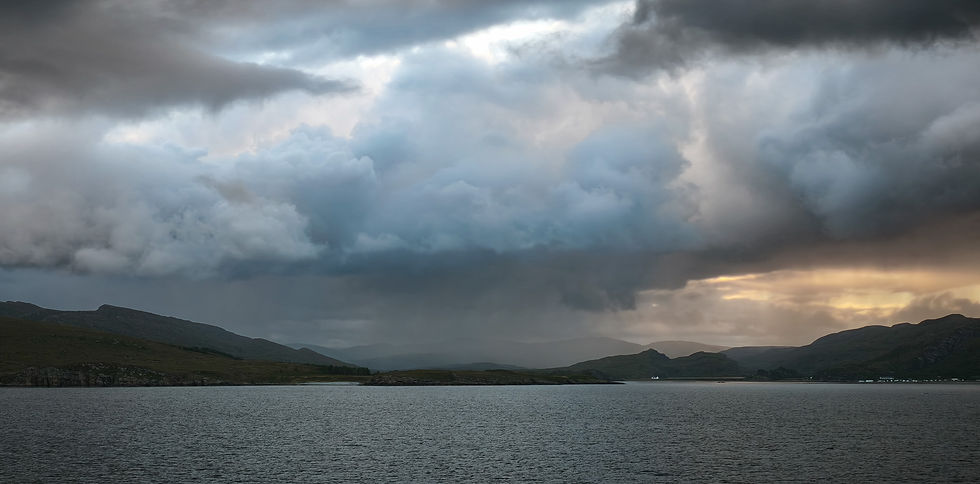
There were some meaty showers around during the day and choosing the wrong moment to leave Borealis could result in you getting very wet, as Peter found out; Paul and Julia timed it a better for getting ashore. There were quite a few eateries available for lunch, but the weather made finding one with any seating space a problem.
The afternoon was glorious, showing Ullapool and Loch Broom at their very best, and Borealis looked lovely anchored in the calm waters with the mountains as a backdrop. There was some interesting marine life to look at in the harbour with lots of Moon Jellyfish and a Grey Seal that was performing near the fishing boat, presumably getting the odd fish thrown its way.
Moon Jellyfish (Peter Howlett/OWE) Grey Seal (Peter Howlett/OWE) Lesser Black-backed Gull (Peter Howlett/OWE) Common Dolphin (Peter Howlett/OWE)
Back on board the team put some effort into a watch from deck eight, which paid off with a couple of sightings of White-tailed Eagle and even better a single Golden Eagle. Sadly, all were very distant.
Sail away was 17:00, we had found out that the passengers who had been on the RIB tours had seen Common Dolphin on their way back from the Summer Isles. An added incentive to keep our eyes peeled, in case we needed it. Sure enough, we had only just left Ullapool behind us when Julia spotted dolphins coming towards the ship, a small group of Common Dolphins. There were far more seabirds in evidence than this morning, with plenty of Shag and auks and gulls flying around amongst the islands. As we set off into the Minch the evening sky looked very dramatic with towering shower clouds dotted about.

31 July – Stornoway
At dawn we were a little southwest of Tiumpan Head, the light from the lighthouse standing out in the early morning light. The breeze was from the southwest, and as we were heading straight into it standing on deck six was out of the question but deck three was very pleasant, especially once the sun had risen a little. There were plenty of seabirds around, especially auks. Guillemots were most abundant but there were good numbers of Razorbill and Puffin too. Several Manx Shearwater put in an appearance dropping in next to groups of auks to feed.

We had one brief glimpse of a Minke Whale, but no other cetaceans showed themselves and there were no real photo opportunities either. We picked up the pilot a little way off Arnish Point and made our way slowly towards the deep water berth, opened in 2024 and still a work in progress.
We docked quite a bit ahead of schedule and well before breakfast was available, so it made sense to stay on deck 6, which was fine now we had berthed. There was plenty to look at: a Red-throated Diver flew over carrying a large fish, which looked like a Great Sandeel; Arctic Tern were numerous; and two or three parties of Greylag Geese flew past (they are considered wild birds up here, unlike the rest of the UK). Even the Rock Doves looked the part and are likely as pure as you get in the UK.
Red-throated Diver (Peter Howlett/OWE) Grey lag Goose (Peter Howlett/OWE) Rock Dove (Peter Howlett/OWE) White-tailed Eagle (Peter Howlett/OWE)
A bird-shaped lump on the nearest lump of land to us turned out to be a White-tailed Eagle. An alert on the WhatsApp group got several guests up to deck six to take a look, two took the trouble to linger and also got to see it fly. Shortly after that a second White-tailed Eagle flew across, then the first bird came back, this time mobbed by Arctic Tern and carrying the remains of either a Common Gull or Kittiwake in its talons. All this before breakfast!

As part of the deep water terminal construction a path was laid to join up with the existing paths around Lews Castle which makes for a gentle and picturesque hour or so walk into town. There were few birds to be seen besides a handful of common woodland species like Chaffinch, Wren, Goldfinch, Siskin, Robin etc. There is a heronry visible from the path and Grey Heron are frequent along the shoreline and overhead. The castle itself sits in manicured grounds but looks lovely, especially if the sun is out.
On the walk two RIBs headed out of the marina, one heading to the Shiant Islands, the other a shorter trip down the coast. Pretty sure Borealis passengers were on one of them at least.
Borealis in Stornoway (Peter Howlett/OWE) Goldfinch (Peter Howlett/OWE) Shiant Islands RIB trip (Peter Howlett/OWE) Lewis RIB trip (Peter Howlett/OWE) Grey Seal dozing (Peter Howlett/OWE) Lews Castle (Peter Howlett/OWE)
As we walked around the port a head popped up in the river, a nice Grey Seal, which sat bobbing there for a few minutes before disappearing. A little further round near the fishing quay there was a bull Grey Seal loafing metres from the quayside. It turned out to be a second animal as another popped up again out in the river. The bull looked like it had been in the wars over the years with several scars visible.
Back on board there were more Grey Seal to be seen with seven loafing on rocks near the quay, although they were soon pushed off by the rising tide. Sail away was 17:00 and we reckoned we’d reach the Shiants just as it was getting dark, so some wildlife spotting potential.
Grey Seal (Peter Howlett/OWE) Grey Seal (Peter Howlett/OWE) Grey Seal (Peter Howlett/OWE)
Shortly after leaving Stornoway, we started seeing large numbers of Guillemot, Razorbill including lots of youngsters, which was heartening. There were even one or two really well feathered Razorbill, suggesting they must have been fledged for three or four weeks – seems very early. Amongst all the auks there were also plenty of Puffin to be seen, although guests were still having trouble picking up one early enough to get a view before they dived ahead of the ship.
Fully feathered juvenile Razorbill (Peter Howlett/OWE) Juvenile Guillemot (Peter Howlett/OWE) Razorbill and Guillemot (Peter Howlett/OWE) Common Seal (Peter Howlett/OWE)
Unfortunately, there were no cetaceans, a little disappointing as we know from sightings on the Stornoway-Ullapool ferry that there are plenty of Minke Whales around. We had to be content with a sighting of a solitary Harbour Seal, which showed quite well. Perhaps surprisingly, the number of birds declined as we headed south and by the time we reached the Shiants there were not many birds to be seen. The feeding must have been really good further north.
1 August – at sea scenic cruising past Dutchman’s Cap and Isle of Staffa
At dawn we were 12km abreast of the island of Rum, one of the Small Isles which in turn are part of the Inner Hebrides, which stretch from Skye to Islay. It was deck three again as we were heading into 15-20 knots of wind. Although mainly cloudy the moon looked fantastic in a clear patch, with some blue sky around it. The clouds also produced some amazing skyscapes over the Small Isles.
The 93% waning gibbous moon (Peter Howlett/OWE) Small Isles sunrise (Peter Howlett/OWE) Muck and Eigg with Rum in the background (Peter Howlett/OWE) The Ardnamurchan headland (Peter Howlett/OWE)
There were also plenty of birds, mainly Manx Shearwater, perhaps not surprising with 110,000 pairs breeding on Rum, but also a good number of auks. As we headed south towards Dutchman’s Cap and Staffa the numbers increased and we were soon seeing rafts of 800-1000 Manx Shearwater and flocks of Puffin and Shag flying past, really spectacular stuff.
Manx Shearwater flock (Peter Howlett/OWE) Puffin flock (Peter Howlett/OWE) Shag flock (Peter Howlett/OWE)
We did a slow cruise past Dutchman’s Cap or Bac Mòr to give its Gaelic name and could just about pick up a few Harbour Seal hauled out on a rocky shelf. We then headed towards Staffa and Fingal’s cave, and although it was sunny it was very hazy and looking towards the cave you couldn’t see too much. When Peter paid a visit last year on the Balmoral the light was superb so the photos here are actually from last year.
Staffa from 2025 (Peter Howlett/OWE) Fingals Cave from 2025 (Peter Howlett/OWE)
Departing the islands the speed increased to 16 knots, and we started our steam back towards Southampton. We passed Dubh Artach, a splendidly isolated lighthouse, first lit in 1872 and it was automated in 1971. Continuing the lighthouse theme we then passed the Rhinns of Islay lighthouse. This one was established in 1825 but not automated until 1998.
As we headed south Manx Shearwater kept us company as did Kittiwake and auks. Numbers rose as we passed Rathlin Island then dipped away before increasing again as we were passing offshore from Belfast Lough.
Flock of Manx Shearwater (Peter Howlett/OWE) Manx Shearwater (Peter Howlett/OWE) Manx Shearwater (Peter Howlett/OWE) Razorbill and chick (Peter Howlett/OWE) Guillemot and chick (Peter Howlett/OWE) Kittiwake (Peter Howlett/OWE) Flight of adult Gannet (Peter Howlett/OWE) Dubh Artach lighthouse (Peter Howlett/OWE) Rhinns of Islay lighthouse (Peter Howlett/OWE)
It was around here that we were watching a very active feeding flock of Manx Shearwater and Gannet when a Minke Whale surfaced in amongst them, it rolled then when it reappeared a few seconds later it was heading back the other way. Peter managed to get some photos, but the sighting lasted just 52 seconds from first sighting to losing sight of it behind us.
There had been some impressive overfalls – patches of very disturbed water caused when a current forces water to rise up over features on the sea floor – off Rathlin Island but the light had been poor for getting a photo. There was another patch offshore from Larne where the seafloor rises from around 120m to as little as 30m, it’s always impressive to see these and in bad weather they can make the sea a churning mass of white water.
Gannet diving and Manx Shearwater (Peter Howlett/OWE) Minke Whale (Peter Howlett/OWE) Irish Sea overfalls (Peter Howlett/OWE)
The end of the penultimate day at sea, the Minke was great, but this has still been a very poor trip for cetaceans. Still, we have one more day.
2 August – at sea Pembrokeshire to Lyme Bay
Our last day at sea dawned with a sea state zero off the Pembrokeshire coast of Wales, the top of Ramsey Island just visible on the horizon with the Preseli hills in the background. Even before sunrise it was possible to pick out dozens of small groups of Common Dolphin feeding almost wherever you looked. We were in the process of being overtaken by a container ship tracking in the same direction as us but doing about one knot more and amazingly it was close enough to see the dolphins riding the bow wave and leaping ahead of it.
Pembrokeshire sunrise (Peter Howlett/OWE) Bow-riding Common Dolphin (Peter Howlett/OWE)
Unfortunately, the wind freshened pretty quickly and put paid to picking up any distant pods of feeding dolphin. The rest of the morning was quiet with just occasional flocks of Manx Shearwater; there are upward of 500,000 pairs nesting on the Pembrokeshire islands of Skomer and Skokholm so there should be a few around.
Towards the middle of the day as we were approaching Land’s End the wind dropped again and we were back to sea state zero. Almost immediately we started picking up scattered pods of Common Dolphin. Most were feeding and we passed within a few hundred metres of some but they showed no interest in coming into bowride. Fortunately, a few did and we and the guests had some fabulous views as they came leaping alongside Borealis. We also picked up a couple of very distant Minke Whale.
Common Dolphin (Peter Howlett/OWE) Common Dolphin (Peter Howlett/OWE) Common Dolphin (Peter Howlett/OWE)
As we passed Land’s End the wind picked up just enough to ruffle the sea surface and make it difficult to pick up distant dolphins. However, we did still pick up a few and then near the Lizard we came across some tuna feeding frenzies, the first had Common Dolphin as well, others didn’t. They were most likely Blue-fin Tuna, which only reappeared in UK waters as recently as 2017-18 – there are now hundreds seen each year.
Fin Whale (Julia Mottishaw/OWE) Fin Whale (Peter Howlett/OWE) Tuna sp. (Peter Howlett/OWE) Tuna sp. (Peter Howlett/OWE)
We were watching a group of tuna when a huge blow rose up – Fin Whale – two of them! The guests had been excited with the dolphin the ones who saw the whale were over the moon. What a fantastic end to the cruise. It had been a poor cruise for cetacean sightings, today rescued it and then some. After the whales and the last tuna frenzy the sea went very quiet, with no seabirds and just the very occasional dolphin sighting.
One last sighting of note; around 13:00 we picked up an adult Gannet riding the updraft over the bow. The undertail area was bright red, and it was obvious from photos that it must have damaged a leg somehow. It still had two legs but whether both were still useable we couldn’t tell. It stayed with us for several hours but eventually peeled away, most likely to head towards the Gannet colonies near Alderney.
Injured Gannet (Peter Howlett/OWE) Injured Gannet (Peter Howlett/OWE)
A very enjoyable cruise with a large number of seabirds seen, even on port days, and the cetaceans rescued by the last sea day. Below are the totals OWE logged for the cruise.
Acknowledgements
The Ocean Wildlife Encounters team would like to thank Fred. Olsen Cruise Lines, the Captain and crew of MS Borealis for their support and looking after us so well. We would also like to thank the cruise guests who took the time to attend our talks and join us on deck watches, sharing the incredible wildlife and scenery of Scotland. Hopefully we’ll see a few of you on forthcoming cruises with Fred. Olsen.


Comments