

S2603 Exploration of South America and the Antarctic - Leg 4 Callao, Peru-St John's Antigua
Callao
Callao was the third change-over port for the OWE teams and an overnight port for the cruise. James and Jean departed Borealis early morning to head off on a three week trip to explore more of Peru, while the incoming team of Peter Howlett and Jeff Clarke arrived on Borealis in the evening. There was time to greet some familiar faces in the Earth Room before bunks beckoned after nigh on 20 hours travelling.
Inca Tern Belcher's Gull Inca Tern
(Click on an image to open it in a new window)
The team were greeted by thick fog early morning, which rather hampered looking for birds from the Borealis, although the Inca Tern and Belcher’s Gull were close enough to be seen despite the fog and the background sound of the port was the calls of a large number of Franklin’s Gull. As the fog banks broke up it became apparent just how many Franklin’s were in the port – a well-known stop-off point for the species on their spring migration. There were thousands sat on wharfs adjacent to Borealis and many more thousands swirled around in the sky in various parts of the docks. We thought it likely there were at least half a million Franklin’s Gull present during the day and there could easily have been more.
Franklin's Gull Flock of Franklin's Gull
By late morning, the fog had cleared enough to make it worth catching the shuttle bus to Miraflores, an area of the city safe enough for visitors to walk around. First stop was a small park which held numerous Vermillion Flycatcher and several Amazilia Hummingbird and a flock of Blue-and-white Swallow. The road and path followed a tree-lined, steep-sided valley down towards the coast. This brought us a few more species, including Eared Dove, Croaking Ground Dove, Long-tailed Mockingbird and Scrub Blackbird.
Eared Dove (Jeff Clarke) Croaking Ground Dove (Jeff Clarke) Long-tailed Mockingbird (Jeff Clarke)
The walk brought us to the long, pebbly beach with a decent Pacific swell breaking on shore, This had attracted a large number of surfers, and we were regularly offered the chance to have a go as we walked past all the surf shacks along the beach top – an offer neither of us felt inclined to accept. None of the surfers could match the skills of a passing pod of Common Bottlenose Dolphin.
Franklin's Gull (Jeff Clarke) Belcher's Gull (Jeff Clarke) Spotted Sandpiper (Jeff Clarke)
Offshore there were large numbers of Inca Tern, Neotropic Cormorant and Peruvian Pelican flying to and fro. Onshore all the lamp post and power lines were festooned with Franklin’s Gull with a few Belcher’s Gull and Neotropic Cormorant. The beach was too busy for much bird life though we did pick up a rather nice ‘spotty’ Spotted Sandpiper.
Amazilia Hummingbird (Jeff Clarke) Peruvian Sheartail (Jeff Clarke) Brown Peruvian form of Vermillion Flycatcher (Jeff Clarke) Normal male Vermillion Flycatcher (Jeff Clarke) Shiny Cowbird (Jeff Clarke) Peruvian Squirrel (Jeff Clarke)
Having decided the beach wasn’t going to provide any more for us to see we headed up to the cliff-top parks and soon found more Amazilia Hummingbird and the delightful and tiny Peruvian Sheartail (another hummingbird, though sadly lacking the long tail). These parks proved fruitful, with many hummers, Vermillion Flycatchers and Shiny Cowbirds. We also added a second mammal for the day, in the form of a rather smart looking Peruvian Squirrel.
Turkey Vulture Black Vulture Franklin's Gull flock
Back on board we continued watching the spectacle of clouds of Franklin’s Gull sweeping past and also caught some Black and Turkey Vulture in lovely evening light. Borealis was due to sail at 23:30, waiting for guests who had done the Machu Picchu extension to return to the ship. This late departure meant we would only be something like 80 nautical miles from Callao at first light.
At Sea
We were on deck six around first light and already it was possible to see hundreds of birds streaming east-west ahead of us. We were still over the continental shelf so can only assume the birds had been feeding inshore overnight and were now heading back offshore. There were thousands of Sooty Shearwater and hundreds of Swallow-tailed Gull and Pink-footed Shearwater in this movement, which continued for several hours. By the end of the day, we logged over 30,000 Sooty Shearwater, 1,200 Swallow-tailed Gull and 600 Pink-footed Shearwater. However, the best was yet to come in terms of number of birds.
Sooty Shearwater Swallow-tailed Gull Pink-footed Shearwater
Around 08:00 we started picking up the first petrels, mainly Elliot’s and Markham’s Storm Petrels along with a few Wedge-rumped and Hornby’s Storm Petrels. Numbers were small at first, just the odd flock passing the Borealis but as the morning went on the flocks grew in size and number until there was almost always a flock in sight, ranging from several hundred to well over 1,000 birds.
Elliot's Storm Petrel Markham's and Wedge-rumped and Least Storm Petrels
It really was an epic sight to see the birds rafting tightly together on the surface then taking flight as we approached and then spreading out. Elliot’s Storm Petrel was by far the most numerous followed by Markham’s, Wedge-rumped and then Hornby’s. However, on reviewing some photos we realised we’d missed a species – Least Storm Petrel with quite a few mixed in the bigger flocks, but only visible in the photos. A conservative estimate of 50,000 Elliot’s went in the log along with 3,500 Markham’s.
Storm Petrel raft Storm Petrels
In amongst all the flocks of storm petrels was an almost continuous trickle of Waved Albatross, most stayed well away from the ship but every now and then one would come a little closer giving a good view of these mainly grey birds with a white head and huge yellow bill, we ended the day with an impressive 1,800 logged.
Waved Albatross Waved Albatross (Jeff Clarke) Waved Albatross
Other birds seen during the day included our first Blue-footed Booby, a mixed flock containing a couple of Peruvian Booby passing early morning. Gulls, terns and skuas were also very prominent with several hundred Sabine’s and Franklin’s Gull seen along with 800 South American Tern and 300 American Black Tern. A close fly-by from a Guanay Cormorant was a little bit of a surprise. Meanwhile, skuas were represented by 14 Pomarine (many adults with full tails), two Arctic and one Long-tailed. For any seawatching birder coming from the UK it’s always a bit special to see a few skuas.
Blue-footed and Peruvian Booby Belcher's Gull Guanay Cormorant Pomarine Skua
Cetaceans were slow to get going with a pod of 40 Dusky Dolphins and a pod of four Bottlenose Dolphin to get the ball rolling on this leg early morning. We then had to wait until late afternoon before the next identified sighting, another group of Bottlenose Dolphin, this time 15. Shortly after a pod of four Risso’s Dolphin appeared – an addition to the cetacean list for the cruise. They were followed shortly after by another six Risso’s and a further eight Bottlenose. Two more pods of Risso’s went past, making a total of 37 for the day. Then, shortly before sunset we had a run of Bryde’s Whales with a loose group of three seen followed by a group of four. Not bad for our first day at sea.
Dusky Dolpin Bottlenose Dolphin Risso's Dolphin Spine-tailed Devil Ray
There were also a few other marine animals recorded during the day, including six South American Fur Seal and four South American Sealion, a Manta Ray and at least 20 Mobula ray species. Peter managed to get a photo of one leaping which was identified as a Spine-tailed Devil Ray.

A pre-dawn walk of the open decks revealed just one nocturnal animal on board, a Hyles annei, one of the sphinx moths (hawk moths).
At Sea
Our second day at sea dawned sunny and warm with a light breeze blowing from the NE. The first pod of around 300 Common Dolphin went past at 06:50 – shortly after it was light and they carried on like that at regular intervals throughout the day. If yesterday had been about storm petrels, today was about Common Dolphins, by the end of the day we had logged 12,400! A staggering total that neither of us had seen anything like before in a day.

Apart from a small group which came in close early morning the pods generally remained very distant and were not conducive to exciting viewing, although seeing splashing extending over a nautical mile or more of sea for some of the pods was impressive.
As if that wasn’t enough, we also had a bit of a Fin Whale frenzy around the middle of the day. Fin Whales don’t generally breach very often and when they do it’s just a single leap. For reasons known only to them we came across Fin Whales that breached multiple times, one or two of the animals breaching 30-40 times. They were several nautical miles away, but it was still a very impressive sight and because it happened so many times, we were able to get all the guests who were on deck with us onto the display. A truly memorable event.
Fin Whale Fin Whale Fin Whale Fin Whale Fin Whale Fin Whale
In the middle of the Fin Whale display, we picked up a large, rounded dorsal fin and tail fin showing above the surface, there was only one thing it could be – Whale Shark. Almost unbelievably, a second then passed down the starboard side of Borealis barely 50m from the hull, so close you could make out the shape and skin patterning under the water. For some this was the highlight of the cruise and certainly an animal neither of us had encountered before. A morning beyond superlatives.

Birds were comparatively thin on the ground, but only in the context of the previous day, Blue-footed Booby was the most numerous with 400 recorded during the day. Black Petrel is a globally scarce species, with a population of around 3000 birds, they spend the non-breeding season around the Galapagos and the waters off the coasts of Ecuador and Colombia, so we were fortunate to see as many as 150 today. Another scarce species seen was Galapagos Petrel, the global population for this species is thought to number around 40,000 individuals, we saw 90 during the day.

Common Dolphin Common Dolphin
During the late afternoon, a few pods of Common Dolphin came a little closer to Borealis and put on a good show as they powered past us, their bodies lit by the late afternoon sun.
There was a good variety of other wildlife seen during the day, we had good views of a Green Turtle as it went past down the port side, and a Loggerhead Turtle was also seen. A couple of Sunfish and another Manta Ray added to the diversity.
Green Turtle Hornby's Storm Petrel Vine Sphinx (Hawk) Moth
Overnight we picked up a Hornby’s Storm Petrel which was released early morning. It immediately spiralled high into the air, did several loops like a homing pigeon, and once it had reset it’s compass it made a beeline for home. The other stowaway on board was a large Vine Sphinx (Hawk) Moth.
At Sea
Dawn on the 21st March, our third sea day, was something a little special, with a sea state 0 and just enough haze to soften the harsh tropical sun, it was magical up on deck six. We had hoped that we would pass Isla de la Plata a little later but as it was, we were just past it at dawn. The island is home to large numbers of boobies as well as Waved Albatross and we had hoped that passing during the day would give us a chance to see some of the island’s birds.

As it was boobies were certainly flavour of the day, albeit in fairly small numbers, with 100 Red-footed Booby and 20 Nazca Booby being as numerous as they got. A lone Brewster’s Booby joined the ship for a few minutes and was notable as it has recently been split from Brown Booby, so a new species for many.
Bottlenose Dolphin Short-finned Pilot Whale
However, given the calm conditions we were on the hunt for beaked whales, and we were both hoping for a glimpse (or better) of a Peruvian Beaked Whale. The morning got off to a good start with a small pod of six Short-finned Pilot Whale passing close down the port side, the sea was so calm that the fins could be seen with the naked eye at long-range. Cetacean sightings kept coming at regular intervals with a pod of 12 Bottlenose Dolphin and a pod of 100 Pantropical Spotted Dolphin along with one or two small pods. A guest picked up three distant, slow rolling animals and we struggled to get anything on them as they disappeared for short periods. Fortunately, Jeff had a pair of 18x40 stabilised binoculars and managed to get enough on them to identify them as Blainville’s Beaked Whale.
Another pod of 60 Pantropical Spotted Dolphin went past then another group of five large, slow-moving cetaceans were spotted. At the time identification was uncertain but looking at photos on the laptop later in the day we were able to identify them as Longman’s Beaked Whale, an excellent addition to the cruise cetacean list.
Striped Dolphin Risso's Dolphin Risso's Dolphin
A couple of small pods of Striped Dolphin and a pod of very white Risso’s Dolphin added more species to the day’s list and we ended with eight species of cetacean for the day. The wind had freshened during the morning, and the sea conditions put paid to anything other than very obvious dolphins being seen.
Blue-footed Booby Brewster's Booby
The boobies had been keeping us entertained during the day catching some of the numerous flying fish being flushed by Borealis but by 14:30 even they gave up on us and there wasn’t a wildlife sighting for over three hours.
Brown Booby Brown Booby Nazca Booby Nazca Booby Red-footed Booby Red-footed Booby
A pod of 30 Common Dolphin were seen towards sunset, bringing the day’s sightings to a close. We hadn’t managed a glimpse of Peruvian Beaked Whale but the Longman’s and Blainville’s were a decent substitute.

The Vine Sphinx Moth population had doubled overnight, and they were joined by another smart-looking moth a Citheronia hamifera. It was great that a few of the guests were still letting us know about moths as well as birds and cetaceans – a testament to the work of the earlier OWE teams.
At Sea
The weather for our final sea day before Panama City was less than ideal, 20 knot winds from the NE kicking up a lot of white caps and making deck six a no-go area. Birds were few and far between, apart from Nazca Booby, but there was a little excitement along the way.
Galapagos Shearwater Galapagos Petrel Red-billed Tropicbird
Almost the first bird seen was a Black Storm Petrel, relatively close in, it tracked alongside for a few seconds before heading away from the ship. A short time later another dark petrel appeared, this time a Chapman’s Storm Petrel. Two Galapagos Shearwater, and singles of Wedge-tailed Shearwater and Galapagos Petrel made for an interesting morning.
Nazca Booby diving Nazca Booby shallow angle dive
A couple of small flocks of American Black Tern, three Royal Tern, and two Red-billed Tropicbird added to the list during the day and were the only non-boobies, or petrels, seen during the day. Still, the boobies were entertaining and so close into the ship you could almost reach out and touch them as they went past deck three.
Nazca Boobies squabbling over a fish Nazca Booby moving a fish around to swallow it head first Nazca Booby moving a fish around to swallow it head first Nazca Booby moving a fish around to swallow it head first
Given the sea conditions, it’s perhaps not surprising that cetaceans were elusive today, just a handful of small pods of distant dolphins seen amongst the waves and none of them seen well enough to identify. Despite the conditions three Green Turtle were seen during the day, as well as another two unidentified turtles.
Amador, Panama City
First light on the 24th saw us approaching the port of Amador, Panama City, there were many ships at anchor and other vessels lining up to approach the canal but despite all that we still saw two Bryde’s Whale and a pod of 50 distant dolphins. It appeared there was actually a large amount of fish available in the area as there were feeding flocks of gulls, terns, and pelicans all over the place.

Amador was another overnight port; we were due to leave at 04:30 to begin our canal transit shortly after dawn. This gave Jeff and Peter the chance to do a full day’s birding with a local guide which will be covered in a separate blog.
Panama Canal transit
For many, after the Antarctic Peninsular and the Falklands, the canal transit was a highlight of the cruise. At dawn we were making our way very slowly towards the Miraflores locks and underneath the Bridge of the Americas.


Wildlife was plentiful from the start with hundreds of Brown Pelican, Neotropic Cormorant, Laughing Gull, and Royal Tern while we were still in open water. As we neared the lock Great Egret and Cattle Egret appeared and a few guests glimpsed a Capybara grazing in fields just before the locks. An early alert from a guest took us to a beautiful Anchemola Sphinx Moth, at about 7cm across its closed wings, the largest moth we’ve seen on board.
Transit through the Miraflores lock was surprisingly quick, although plenty enough time to watch the Fork-tailed Flycatcher, Great Kiskadee, and Spotted Sandpiper making use of the structures of the locks. Tropical Kingbird were even quick to make use of the masts on Borealis as a temporary high spot to look for prey.
Anchemola Sphinx (Hawk) Moth Summer-plumaged Laughing Gull Fork-tailed Flycatcher Great Kiskadee Spotted Sandpiper Osprey
Osprey were also a conspicuous presence around the locks, using the lampposts as convenient perches to eat the fish they were catching. One or two were very obliging passing over deck six against some clear blue sky.
From a wildlife point of view the highlight of the first couple of hours was the raptor passage. March is peak migration season for many birds migrating from their winter homes in South America to breeding quarters in North America and, although not as big a spectacle as the autumn, there can still be thousands of raptors seen.
'Kettle' of vultures Black Vulture Turkey Vulture Swainson's Hawk Broad-winged Hawk Wood Stork
Today, numbers were in the hundreds rather than thousands, but it was still impressive, with large flocks of Black and Turkey Vulture kettling over hills before moving off to the west. However, on looking at the vultures you realised there were birds way higher, just about invisible to the naked eye, these were mainly Swainson’s and Broad-winged Hawk from those we could identify and in the space of a couple of hours hundreds had gone over. Other soaring birds joined the kettles too, with several Wood Stork seen during the morning, these large birds also rely on thermals for migration and behave in the same way as the birds of prey.
White-tailed Deer American Crocodile
After passing through the Pedro Miguel Lock, we were into the Culebra cut, the narrowest part of the canal and an impressive feat of engineering. From there it’s on to the Chagres River section, slightly wider and very winding. White-tailed Deer and American Crocodile were spotted while we were in these narrow sections as the banks were only metres away.
Magnificent Frigatebird were a constant companion along the canal, and it was interesting to watch a flock of them bathing in the fresh water of the lake.
Magnificent Frigatebird Magnificent Frigatebird bathing
Frigatebirds don’t have waterproof feathers and can’t sit on the water to bathe like other seabirds, as a result they need to dunk themselves into water whilst flying, making sure they don’t get too wet.
Once into Gatun Lake the scenery is impressive, and the scale of the lake emphasised when large ships just appear from the forest as they round a bend. However, as the banks are now much further away it was more difficult to spot anything. It didn’t help that the water levels were higher than normal which meant that all the muddy or sandy banks, areas which would be used by crocodiles, were covered.
Rather helpfully, the passage of Gatun Lake coincided with lunch, which was very welcome and meant that we were refreshed ready to continue watching wildlife as we approached the Gatun Locks, a series of three locks which drop vessels the 26m from lake level back to sea level.

At these locks Grey-breasted Martin and Short-tailed Swift were very numerous, zooming around the ship and we were once again buzzed by Osprey low overhead.
Grey-breasted Martin Short-tailed Swift Osprey
Once through the three locks we made our way through the navigation channel in Colón harbour towards the open sea, now the Caribbean Sea rather than the Pacific.
Unfortunately, there was an immediate and very obvious difference between the two, whereas there had been thousands of birds on the Pacific side now there were virtually none. We saw a handful of Laughing Gull and the odd Magnificent Frigatebird as we made our way through the harbour, but once in open water there was nothing.

Through the late afternoon the odd Brown Booby appeared alongside and the occasional Magnificent Frigatebird but otherwise it remained quiet. One frigatebird decided to rest on board – a fairly unusual event – and perched on the foremast, for a moment it looked like it might stay until sunset but lifted off a little before.
There had been no cetacean sightings all afternoon, then, just before sunset a couple of our regular guests appeared on deck six and said they had just had a whale blowing several times off to port. We searched with renewed vigour and were rewarded with finding seven Sperm Whales – thankfully saving us from a blank cetacean day. They were logging on the surface and never came that close to the ship, but an excellent way to round off the day.
Puerto Limón, Costa Rica
A pre-dawn walk around the decks of Borealis brought with it a little excitement. There had been rain showers overnight, and in particular in the last hour or so and as a result there was an unidentifiable small flycatcher on deck three and then up on eight there was a Sulphur-bellied Flycatcher, a good bird for Costa Rica.
Sulphur-bellied Flycatcher Sulphur-bellied Flycatcher
Chuck-wills-widow Lesser Nighthawk
As we were standing on deck six a bird hurtled around the side of the bridge and passed within a few metres of us, it was one of the North American nightjars – but which one? A quick check of photos told us it was a Chuck-Wills-Widow, what a fantastic start to the day. Shortly after a Cattle Egret (one of five) made its way past but decided to perch on the bow rail.
Cattle Egret Cattle Egret
Another walk around the decks revealed a second Sulphur-bellied Flycatcher and another member of the North American nightjar family – this time a Lesser Nighthawk. The Chuck-Wills-Widow was also seen perched on the rail of deck nine but was unfortunately flushed before a photo could be taken. A spectacular start to the day and one that was so unexpected.

We had been unable to find a guided tour for our day in Costa Rica so when two spaces became available on a Tortuguero Canal tour organised by John Marshall, one of the keen photographers on board, we leapt at the chance.
Green Heron Tricoloured Heron Yellow-crowned Night Heron Little Blue Heron Bare-throated Tiger Heron Northern Jacana Grey-cowled Wood Rail Green Kingfisher (Jeff Clarke) Amazon Kingfisher 3-toed Sloth White-faced Cappuchin Spectacled Caiman
There were ten of us in the tour boat, so we all had plenty of room, just as well as nearly everyone was a photographer. The tour lasted four hours and gave us some fabulous views of some of the canal-side wildlife. In particular: Green Heron, Tricoloured Heron, Little Blue Heron, Yellow-crowned Night Heron, Bare-throated Tiger Heron, Northern Jacana, Grey-cowled Wood Rail, Green Kingfisher, and Amazon Kingfisher. There were also a handful of non-avian highlights, in particular a female Sloth with a youngster, a White-faced Cappuchin and a small Spectacled Caiman.
Before returning to Borealis we spent a short time in the little park next to the dock, which was home to a surprising variety of birds including Grey-capped Flycatcher and Scissor-tailed Flycatcher Only managed a poor photo in the top of a tree), both new for the leg as well as numerous Summer Tanager and Crimson-fronted Parakeet.
Grey-capped Flycatcher Scissor-tailed Flycatcher Crimson-fronted Parakeet
We sailed just on sunset so there was no wildlife to be seen as we departed.
Colón, Panama
We arrived in Colón shortly after dawn with little to be seen as we came in other than a handful of Magnificent Frigatebird and a few Laughing Gull. Today we had booked another birding tour which would take up most of the day, we’ll cover this in the blog along with the first day in Panama.
We set sail after sunset so there were no further sightings from the ship for the day.
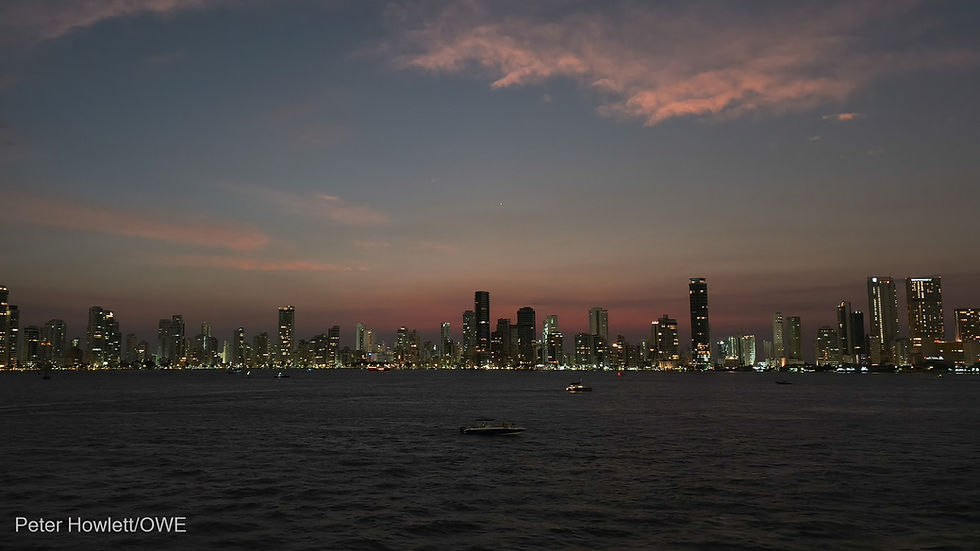
At sea and arrival into Cartagena, Colombia
There was a very warm 15 knot NE breeze to greet us when we got on deck and, unfortunately, in the six hours from first light until we got to the islands outside of Cartagena there was virtually nothing to see. A handful of Red-footed Booby and a distant pod of 30 Pantropical Spotted Dolphin were the sum total.
Red-footed Booby Red-footed Booby Sandwich Tern
Things improved in the environs of the port with a large number of Magnificent Frigatebird, Brown Pelican, Laughing Gull, Royal Tern, and our first Sandwich Tern. There were also quite a few egrets flying around and a Great Blue Heron on one of the beaches we passed.
There’s an eco-park inside the secure area of the dock, which is part zoo, part wildlife park. There are a huge number of macaws and amazons of various species living there, all free-flying but choosing to stay there, presumably as food is plentiful.
Blue-and-yellow Macaw Scarlet Macaw Crimson-fronted Macaw
The captive ibis and Flamingos attract wild birds in, and the trees hold a good number of small birds and species such as Great-tailed and Carib Grackle. In the day and a half here between us and the guests a good list of species was amassed.
White Ibis Chestnut-winged Chachalaca Chestnut-winged Chachalaca Great-tailed Grackle Black-crowned Night Heron Bicoloured Wren
Our second day in Cartagena was a guided tour of a nearby private forest reserve; this will be covered in the off-piste blog along with the days in Panama.
Being alongside overnight a couple of interesting insects were found onboard in the morning, a large Fig Sphinx moth and an equally impressive Ceiba Borer Beetle.
Fig Sphinx moth Ceiba Borer Beetle
We sailed after sunset, so no sightings from the ship at sea.
At sea
The weather was not playing ball; a 20-25 knot NE breeze had pushed up lots of white caps and a reasonable swell. Finding any cetaceans today was going to be down to luck or as was the case, if they came into the side of the ship. Unfortunately, the three Pantropical Spotted were seen so briefly that we barely saw enough to be able to identify them before they were gone – still at least not a cetacean-free day.
Sargasso Shearwater Black-capped Petrel Black-capped Petrel
Birds didn’t fare much better, although to be fair 18 of the birds we did see were pretty special – Black-capped Petrel. Although seen in this part of the Caribbean, as far as we could tell seeing this many might be unusual, we also saw both the dark and light-faced morphs. Other birds logged included four Sargasso Shearwater, five Pomarine Skua, eight Least Tern, three Red-billed Tropicbird, and seven Masked Booby amongst others.
Peter at least had an excuse to get off the deck, finalising the round-up presentation during the final sea day.
Willemstad, Curaçao
We came alongside the cruise terminal in Willemstad just after sunrise, around the ship were the usual suspects of Brown Pelican, Magnificent Frigatebird and Laughing Gull – the Caribbean really is rather predictable. Just across the road from the terminal was a small mangrove park, our destination once we were allowed off.

The park, although small, had a well-made boardwalk through it and a reasonable variety of birds, given there aren’t that many on the whole island. Best bird was Venezuelan Troupial – the national bird of Curaçao – though sadly neither of us were able to get a photo of one. A Yellow Oriole certainly lived up to its name as did the Mangrove Yellow Warbler, of which there were several pairs, plus the ever-present Bananaquit.
Yellow-crowned Night Heron Bare-eyed Pigeon Carib Grackle Brown-throated Parakeet Mangrove Yellow Warbler Bananaquit
Yellow-crowned Night Heron were also present, possibly even breeding in the mangroves as there were juveniles present. Eared Dove and Common Ground Dove and Bananaquit were par for the course, but Bare-eyed Pigeon was new. After a couple of hours in the park, it was off for a quick walk around the town and then back on board to continue prepping the final talk.
At Sea
Our final sea day for this leg as we headed north towards the island of Bequia in St Vincent and the Grenadines. The dolphins saved the best until last with a superb show by a pod of 300 or so Gray’s Spinner Dolphin. About 30 of them appeared out of nowhere, right alongside the ship and barely gave us chance to shout out and get people on them before they were gone but then the whole 300 or so popped up in the wake and played for a moment before dropping back – what a way to finish the leg!


A sighting of two Atlantic Spotted Dolphin by two guests just before sunset rounded off the cetaceans.
Bird-wise it was a typical day in the Caribbean with Masked, Red-footed and Brown Booby to the fore. Bird of the day, however, went to a Bulwer’s Petrel seen early morning, possibly quite a bit further west than their range suggests. A Sargasso Shearwater, three Red-billed Tropicbird and singles of Arctic and Pomarine Skua were just about it.
Red-footed Booby Red-footed Booby Masked Booby
Bequia
There were heavy showers around St Vincent and dramatic skies over Bequia as we approached as the sun was rising. Boobies, mainly Red-footed, were heading away from the islands in large numbers, presumably to fishing grounds further west. A few Brown Booby kept us company as we headed in towards the island.


We anchored in the bay, just over a nautical mile from the jetty, far enough that the breeze kicked up a chop that made getting on and off the tender interesting. The island looked pretty from the ship but once ashore was a little rough around the edges, and, as with all the smaller Caribbean islands there were very few birds to be seen.

Carib Grackles were busy nesting near the port area but were few and far between away from the port and nearby hotels. There were Bananaquit a plenty everywhere and quite a few Tropical Mockingbird and Collared Dove, a fairly recent colonist. The other pigeon present was Scaly-naped, we had seen them in Curaçao but not really got good views, so nice to get a better view here. We had read there were Broad-winged Hawks on the island too, as it turned out they were very easy to see, as six of them soared over the hills just in from the beaches. They were much darker than the birds we had seen migrating over Panama, so perhaps resident birds.

The island is graced with two species of hummingbird, Green-throated Carib, and Antillean Crested Hummingbird, we managed to find a few of the latter which made the day. Having exhausted the area in the immediate vicinity of the dock we returned to the ship and had a look out to sea from on board. There wasn’t really very much to be seen, we couldn’t find any dolphins and apart from frigatebirds, boobies and Laughing Gull there wasn’t much happening on the sea.

We sailed just before sunset and had about 30 minutes on deck six before it got dark. The sailaway coincided with the launch of the Artemis 2 rocket and someone had suggested we might be able to see it from the ship. We duly looked towards the NW as it lifted off but couldn’t see anything. It was only after the event that we checked the map to find that Cape Canaveral was about 1,300 nautical miles NW of our position – might have had something to do with us not seeing it.
St John’s, Antigua
We were due to dock at 10:00 so we had a few hours looking at the sea beforehand. Aside from the usual Masked and Brown Booby around the ship there was little to be seen apart from a couple of Red-billed Tropicbird and Magnificent Frigatebird.
As we came in along the coast towards St John’s there was more to be seen with Royal Tern and Laughing Gull putting in an appearance. We were both a bit miffed to hear that two Humpback Whale had been seen just outside the harbour.
This had been a fantastic two weeks with a huge amount of wildlife seen, we had time to have a quick chat with Martin and Mark as they arrived as team five for the journey back to Southampton.


Comments